 how-to
How to Vet Luxury Outdoor Contractors: 7 Proven Steps
Table of Contents
- Why Luxury Outdoor Projects Demand Stricter Contractor Vetting
- Step 1: Build Your Shortlist Through Referrals and Research
- Step 2: Verify Credentials, Licensing, and Insurance
- Step 3: Evaluate Project Experience and Portfolio
- Step 4: Check Outdoor Contractor References and Past Client Reviews
- Step 5: Ask the Right Questions to Ask a Landscape Contractor
- Step 6: How to Compare Contractor Bids Without Getting Misled
- Step 7: Understand the Contractor Project Timeline and Team Oversight
- Frequently Asked Questions
Last Updated: October 14, 2026
Why Luxury Outdoor Projects Demand Stricter Contractor Vetting
Hiring the wrong contractor for a luxury outdoor build can cost you far more than a standard renovation would. A custom pool, spa, or outdoor kitchen involves complex systems, premium materials, and a much bigger financial commitment.
Villefort Luxury Outdoor Living specializes in creating cohesive, custom-designed backyard environments tailored to your lifestyle and home, managing the entire transformation process under one vision. The difference almost always comes down to vetting.
What Makes Luxury Projects Different from Standard Builds
A standard patio or basic deck follows a simple plan. A luxury outdoor build does not.
- Multiple trades must work together: pool, electrical, gas, masonry, landscaping
- Premium materials cost more to replace if something goes wrong
- Design details are custom, not pulled from a catalog
A single weak link, like an uninsured subcontractor, can undo months of work. So the vetting bar has to be higher.
Step 1: Build Your Shortlist Through Referrals and Research
Start with a shortlist of at least three to five candidates. A shortlist gives you room to compare and walk away from a weak option.
Where to Find Qualified Luxury Outdoor Contractors
- Ask neighbors with high-end outdoor spaces who built them
- Check with local landscape architects or pool designers for referrals
- Search online for outdoor contractor references and reviews
Online research and reviews help, but they're a starting point. A common mistake is trusting a five-star rating without checking whether the contractor has actually built anything like your project. A company that installs basic patios may have perfect reviews and still be wrong for a custom pool and pergola combination.
Cross-check every recommendation against real completed projects before you move forward.
Step 2: Verify Credentials, Licensing, and Insurance
Ask for proof of licensing and insurance before any detailed conversation. A serious contractor expects this question and answers it without hesitation.
What to Check on a Contractor License and Insurance Certificate
- A current state contractor license, matched to the name on your contract
- General liability insurance that covers your project's scope
- Workers' compensation coverage for anyone on your property
Confirm the license number through your state's licensing board rather than trusting a document alone. For insurance, call the provider to confirm the policy is active and covers the work being done.
Step 3: Evaluate Project Experience and Portfolio
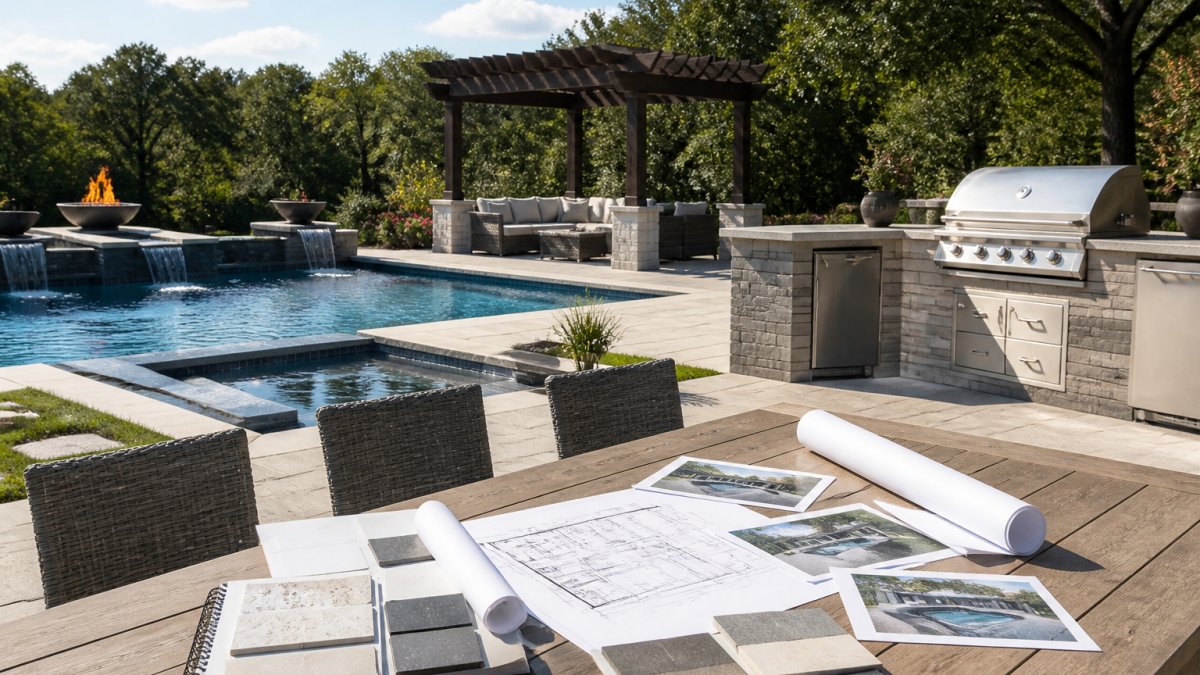
A portfolio tells you more than any sales pitch. Ask to see completed projects that match your project type, size, and style.

How to Review a Contractor's Portfolio for Luxury Craftsmanship
- Look for projects similar to yours, not just any outdoor build
- Check the details: stonework joints, tile alignment, finish quality
- Ask how long each featured project took and what problems came up
Photos hide flaws. If you can, visit a completed project and inspect the craftsmanship up close. Look at how materials meet, whether lines are straight, and how the space has held up over time.
Step 4: Check Outdoor Contractor References and Past Client Reviews
Ask for at least three references from projects finished in the last year or two. Recent references matter most because they reflect how the company operates now.
When you call, ask specific questions:
- Did the contractor stay on schedule?
- How did they handle changes or problems?
- Would you hire them again?
One glowing review means little. A pattern across several clients tells you what to expect.
Step 5: Ask the Right Questions to Ask a Landscape Contractor
The questions you ask reveal how a contractor thinks. Good answers are specific and direct.
- Who will manage my project day to day?
- Will you use subcontractors, and who are they?
- How do you handle permits and inspections?
Vague answers are a red flag. A contractor who can't name their project manager or explain their permit process likely runs a disorganized operation.
Step 6: How to Compare Contractor Bids Without Getting Misled
The lowest bid is rarely the best bid on a luxury outdoor project. Bids are only comparable when they cover the same scope of work, and on a custom pool, outdoor kitchen, or hardscape build, the scope is where bids quietly diverge. The gap between the cheapest and most expensive bid on the same project is often driven less by labor rates than by what one contractor included and the other left out.
Normalizing Bids for Luxury Projects
Put every bid into the same format before you compare. Build a single spreadsheet with one row per line item and one column per contractor, then fill in each cell from the written bid. Where a contractor's bid is silent, mark it "not specified", silence is a finding, not a neutral.
| Bid Element | What to Confirm |
|---|---|
| Scope of work | Same materials, same features, same square footage, same quantities |
| Materials | Brand, grade, color, and finish listed in writing, not "premium stone" |
| Allowances | Dollar amount allowed for each unspecified item (tile, appliances, lighting) |
| Exclusions | What the bid explicitly does not include: permits, engineering, drainage, cleanup |
| Labor | Who does the work, employees or subcontractors, and at what crew size |
| Permits | Who pulls them, who pays fees, who manages inspections |
| Site work | Excavation, grading, haul-off, utility relocation, access protection |
| Timeline | Start date, milestones, completion date, weather contingencies |
| Payment | Deposit, draw schedule, retainage, final payment terms |
| Warranty | Length, what it covers, who honors it, transferability |
Allowances, Exclusions, and Contingencies
An allowance is a placeholder dollar amount for a material the homeowner hasn't selected yet. A $2,000 tile allowance and a $12,000 tile allowance produce very different final invoices even when the base bid looks identical.
Exclusions are the second trap.
Contingency is the third. A responsible luxury bid carries a contingency line, commonly in the range of 10 to 15 percent of hard costs on complex outdoor builds, to absorb unknowns like rock during excavation or a failed inspection.
Comparing Lifecycle Cost, Not Just Build Cost
Two bids for the same outdoor kitchen can differ by thousands of dollars in year five. Compare:
- Material durability: natural stone versus veneer, marine-grade hardware versus standard, stainless steel gauge in a coastal or humid climate
- Maintenance: sealed versus unsealed stone, salt versus chlorine systems, drainage that moves water away from foundations
- Replacement cycles: how long the finish, the grout, the lighting, and the equipment are expected to last
A bid that is 15 percent higher but uses materials with a longer service life and accessible equipment can be the cheaper project over a decade of ownership.
Red Flags in a Luxury Bid
- A single lump-sum number with no line-item breakdown
- "Allowance" figures with no dollar amount attached
- No named project manager or crew
Normalizing bids this way turns a price comparison into a scope comparison. The contractor who wins is the one whose written scope matches what you actually want built, at a price you can trace line by line.
Step 7: Understand the Contractor Project Timeline and Team Oversight
On a luxury outdoor build, the person who sold you the project is often not the person who runs it. The gap between the sales conversation and the jobsite is where most luxury projects go wrong, unfamiliar crews, unsupervised subcontractors, and a project manager juggling six other jobs. Ask for the team structure in writing, then verify it.
Who Will Actually Be on Your Property
Get these names and roles in the contract, not in an email:
- The project manager, by name, with a direct phone number
- The on-site supervisor or lead craftsman for each trade
- Every subcontractor expected on site, with license and insurance on file
How to Vet Subcontractors Before They Set Foot on Site
A general contractor may hold a valid license while the electrician, plumber, or gas fitter who actually wires your outdoor kitchen does not.
A practical pattern: ask the general contractor to provide a certificate of insurance naming you as an additional insured for the duration of the project. This gives you a direct claim path if a subcontractor causes damage or an injury on your property.
Verifying the Team, Not Just the Org Chart
- Ask to meet the project manager and lead craftsman before signing, in person or by video
- Ask how many projects the project manager will run simultaneously during your build
- Ask what percentage of the work is performed by in-house employees versus subcontractors
A contractor who cannot name the project manager, or who says the crew "depends on the schedule," is telling you the project will be staffed reactively.
The Written Timeline and Check-In Cadence
Ask for a written schedule with milestones tied to payments, excavation complete, rough plumbing and electrical inspected, decking installed, equipment set, final inspection. Tie each draw to a completed and inspected milestone rather than to a calendar date.
Set a check-in cadence in writing: a weekly walkthrough with the project manager, a written progress summary, and a defined response time for questions.
Contract Safeguards That Keep the Team Accountable
- A named project manager and a named substitute if that person is unavailable
- A requirement that no substitution of a listed subcontractor occurs without written approval
- A retainage holdback, commonly 5 to 10 percent, released only after final inspection and punch-list completion
Frequently Asked Questions
Should I pay a luxury outdoor contractor 50% upfront?
A 50% upfront payment is unusually high for luxury outdoor projects. Industry best practice ties payments to milestones: a deposit for materials, then progress payments as work is completed and inspected. For a project with custom materials, a larger initial deposit may be justified, but it should never exceed the cost of materials ordered. Always get a written payment schedule in the contract and avoid paying for work not yet done. This protects your investment if the contractor delays or abandons the job.
How can I check an outdoor contractor's references and past projects?
Ask for at least three references from projects similar in scope and budget to yours, completed within the last two years. Contact each reference and ask specific questions: Did the contractor stay on schedule? How were change orders handled? Would you hire them again? Also request to visit a completed project in person to inspect craftsmanship up close. Online reviews and portfolio photos help, but nothing replaces a direct conversation with a past client and seeing the finished work.
What warning signs should I look for when hiring a luxury outdoor contractor?
Red flags include reluctance to provide a written contract, pressure to pay a large deposit upfront, no physical business address, inability to verify licensing or insurance, vague timelines, and bids that are significantly lower than others without clear justification. Also be wary if the contractor cannot name specific projects they have completed or if they dismiss your questions about subcontractors. Trust your instincts: if something feels off during the vetting process, it likely will during construction.
How long should I expect a custom outdoor project to take?
A custom luxury outdoor project, such as a pool with an outdoor kitchen and pergola, typically takes several months from design to completion. The contractor project timeline depends on permit approvals, material lead times, weather, and site conditions. A detailed schedule should be part of your contract, with milestones for design, permitting, excavation, construction, and final walkthrough. Ask for a written timeline and clarify how delays are handled. Expect longer timelines for projects requiring structural engineering or custom fabrication.
Vetting luxury outdoor contractors takes real work, but it protects a major investment. At Villefort Luxury Outdoor Living, we handle the entire process under one vision, from custom design to the final walkthrough, with transparent pricing and a dedicated team on your project from start to finish. If you want a stress-free backyard transformation with clear communication at every step, start your backyard design with us today.