 ultimate-guide
Luxury Pool and Spa Design Trends for 2026
Table of Contents
- Luxury Pool and Spa Design Trends Defining 2026
- Luxury Pool Design Ideas: Geometry, Naturalism, and Infinity Edges
- Pool and Spa Combination Ideas for Resort-Style Backyards
- Smart Pool Technology and Automation in Modern Designs
- Pool Lighting Ideas That Transform Evening Outdoor Living
- Wellness, Sustainability, and Climate Resilience in Pool and Spa Design
- Planning Your Luxury Pool and Spa Project: Budget, Timeline, and Long-Term Value
- Conclusion
- Frequently Asked Questions
Last Updated: October 16, 2026
Luxury Pool and Spa Design Trends Defining 2026
Luxury pool and spa design trends in 2026 center on architectural integration, resort-style amenities, and quiet technology that disappears into the landscape. According to Forbes coverage of 2026 pool design, the defining direction is clean architecture paired with high-end finishes, with pool forms coordinated to the lines of the home rather than treated as a separate feature. That single shift explains most of what follows: geometry, naturalism, integrated spas, and automation all serve one goal, which is making the backyard read as a designed room instead of a hole filled with water.
This guide from Villefort Luxury Outdoor Living covers the trends shaping Dallas-Fort Worth projects, plus what drives cost, what holds up, and what to decide before breaking ground.
Luxury Pool Design Ideas: Geometry, Naturalism, and Infinity Edges
Luxury pool design ideas split into three families in 2026: crisp geometric forms, soft naturalistic shapes, and edge treatments that make water appear to vanish. Mixing them carelessly is the most common design mistake we see.
Clean Geometric Shapes and Architectural Integration
Architectural integration aligns a pool's shape, materials, and elevation with the home's existing lines and finishes. A geometric pool with a sharp cantilevered edge reads as intentional; the same pool in a cottage-style yard reads as an addition. Custom finishes, from poured concrete to large-format tile, tie the deck to the house's palette.
Lagoon-Style and Naturalistic Pool Forms
Naturalistic designs trade straight lines for organic curves, rock formations, and irregular depths that mimic a lagoon, pairing best with heavy landscaping and boulders. The trade-off is maintenance: irregular shapes and natural stone ledges collect debris differently than a rectangle, and the planting needs consistent care.
Infinity, Vanishing, and Overflow Edges
An infinity edge creates the illusion of water meeting the horizon; a vanishing edge does the same on a smaller scale, and an overflow edge lets water spill on multiple sides. All three require careful site grading and a surge tank, and on flat lots they depend on a raised elevation or designed drop, so they belong in the earliest site conversations.
Pool and Spa Combination Ideas for Resort-Style Backyards
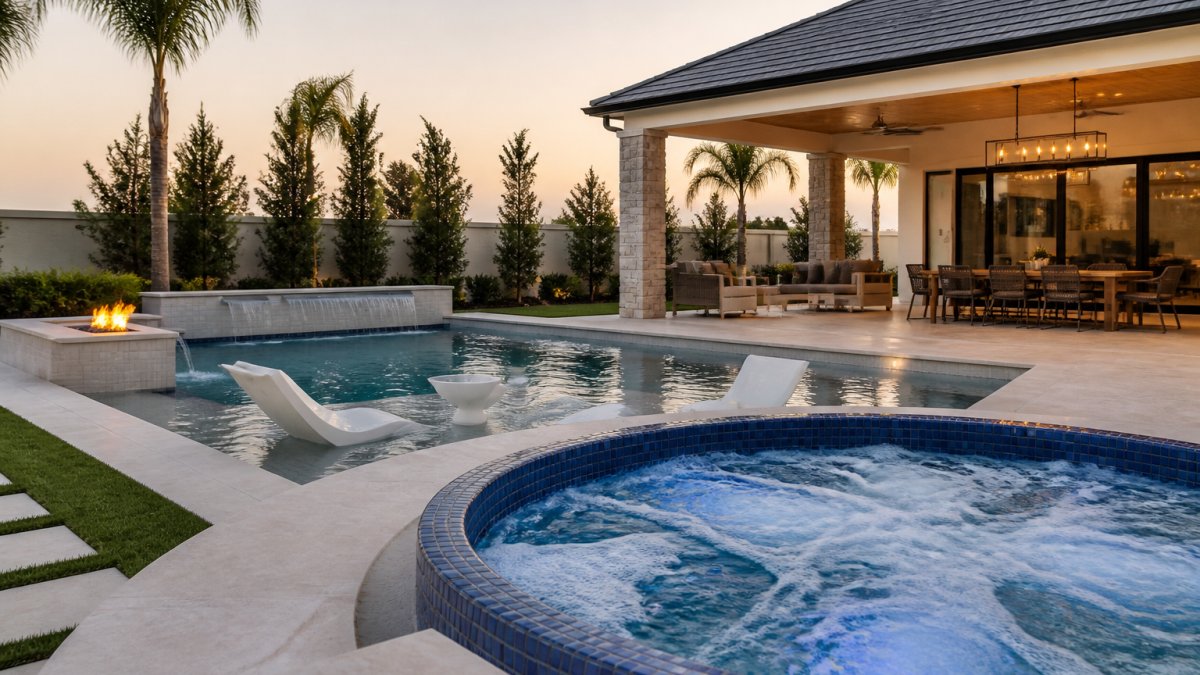
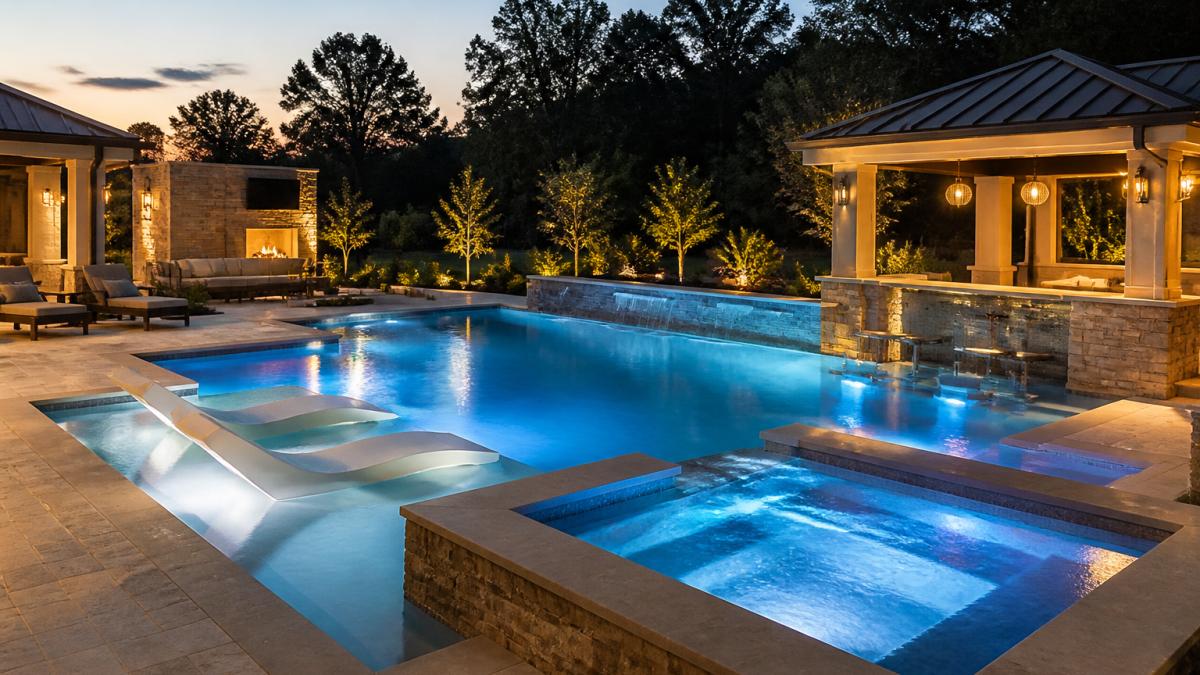
Pool and spa combination ideas work best when the spa is treated as part of the pool's geometry rather than an accessory bolted on afterward. The resort-style backyard, with combined pool-and-spa layouts, swim-up bars, and over-water daybeds, is a leading direction in current design coverage from both Forbes and Luxury Pools magazine.
Integrated and Disappearing Spas
An integrated spa shares a wall and water system with the pool, so it reads as one body of water. A disappearing spa goes further: it sits flush with the pool surface and raises on demand, staying invisible when not in use. Both solve the same complaint, a spa that looks like an afterthought, at the cost of mechanical complexity and service access.
Cocktail Pools, Baja Shelves, and Swim-Up Bars
Compact luxury is driving demand for smaller, deeper-purpose water features. A cocktail pool is built for standing and socializing rather than laps; a Baja shelf, also called a tanning ledge, is a shallow lounging area where water sits a few inches deep; a swim-up bar turns the pool edge into an entertaining station.
Smart Pool Technology and Automation in Modern Designs
Smart pool technology in 2026 is less about gadgets and more about invisible control. Automation handles pump scheduling, chemical monitoring, heating, and lighting from a phone, and other providers list smart automation among the year's leading design directions alongside sustainable design and wellness features. The practical win is energy: a variable-speed pump on a schedule matched to actual use costs less to operate than one running at full speed on a timer.
What Actually Belongs on the Automation Bus
Most luxury projects in 2026 automate four systems, in this order of payoff:
- Pump and filtration scheduling, variable-speed pumps let you run longer at lower RPM, which moves the same water for less energy and less noise. This is the foundation layer.
- Heating control, a setpoint tied to actual use rather than a standing temperature. A spa that heats on demand instead of staying hot all week is the difference between a modest and a painful utility bill.
- Lighting zones, pool, spa, and landscape on separate circuits so one evening can be quiet and the next can be an event.
The Over-Automation Trap
Where homeowners get burned is over-automation. Every added sensor and actuator is another component that can fail, and proprietary systems can lock you into one service provider. A common pattern is a system with a dozen automated functions where two or three are used daily and the rest sit idle until they fail.
Service Access Is a Design Decision
Automation equipment is only as good as its accessibility. Specify a dedicated equipment pad with clearance for service, isolation valves on every line, and a controller location a technician can reach without moving furniture or climbing over landscaping. If the equipment isn't reachable, every future repair becomes demolition, the same limitation that applies to disappearing spas applies to the automation cabinet that runs them.
What to Decide Before You Specify
Decide what you actually want to control remotely, then specify accordingly. Lighting and heating are worth automating first; chemical dosing is worth it if you travel. Pump scheduling is non-negotiable on a new build. Everything beyond that should earn its place by solving a real problem.
Where Automation Meets Sustainability
Automation is also the mechanism behind most measurable sustainability gains. A variable-speed pump on a matched schedule, a heater that only runs when needed, and lighting on a timer rather than a switch all reduce energy use in ways you can see on a utility bill, automation as the control layer for efficiency, not just convenience.
Pool Lighting Ideas That Transform Evening Outdoor Living
Pool lighting ideas determine whether a backyard works after sunset, and most projects under-light the surrounding space while over-lighting the water.
A layered approach covers four zones:
- In-water lighting: LED fixtures in warm white or color-changing, positioned to wash the pool walls
- Edge and step lighting: small fixtures that make level changes visible and safe
- Landscape uplighting: fixtures aimed at trees and sculptural elements to extend the visual space
Color-changing LEDs have become the default because one fixture now serves both a quiet evening and an event. Set them on separate zones so the spa, pool, and landscape can be controlled independently.
Wellness, Sustainability, and Climate Resilience in Pool and Spa Design
Wellness and sustainability have moved from marketing language to specification decisions. Swim-in-place current systems turn a small pool into a fitness option without a lap pool's footprint, while the sustainability changes that show up in operating costs are variable-speed pumps, LED lighting, and covers that reduce evaporation.
Wellness Features That Earn Their Footprint
Wellness in a luxury pool is about how the water gets used. Three features consistently justify their space:
- Swim-in-place current systems, a propeller or jet creates adjustable resistance in a pool as short as 10 to 15 feet, so a compact pool supports swimming, walking, and low-impact exercise. The trade-off is that the current is directional; you swim against it, not around it.
- Integrated spas with ergonomic seating, contoured benches, neck jets, and a raised spillway that doubles as a water feature. The wellness benefit is real; the maintenance cost is a second body of water to balance and heat.
- Shallow lounging zones, Baja shelves and tanning ledges let people be in the water without being fully submerged, extending the season and the age range of users.
Sustainability With Numbers You Can Check
The sustainability conversation gets vague fast. Here is where the measurable gains come from:
- Variable-speed pumps replace single-speed pumps and let you run longer at lower RPM. The energy difference is the single largest operating-cost lever in most pools, and the upgrade most worth making on an older system.
- LED lighting replaces incandescent and halogen fixtures and draws a fraction of the power while lasting far longer.
- Covers reduce evaporation, which reduces both water replacement and the heating load needed to hold temperature. A cover is unglamorous and consistently one of the highest-return additions.
None of these are exotic. They are the difference between a pool that costs what you expected to operate and one that surprises you every month.
Climate Resilience Is a Design Input, Not an Upgrade
Climate resilience matters more in North Texas than most design guides admit. Intense summer sun raises evaporation and chemical demand; freeze events stress exposed plumbing and equipment. Shade structures, proper equipment placement, and freeze-protection planning are baseline decisions for this region, not upgrades.
Skipping freeze protection on exposed plumbing is the most expensive shortcut in this market. A single hard freeze can crack lines and equipment that cost far more to replace than the protection would have cost to install.
The Maintenance Reality Behind Every Wellness Feature
Every wellness and sustainability feature carries an ongoing responsibility, and trend coverage rarely says so. A spa needs its own water chemistry and heating schedule; a swim current needs an annual inspection of the propeller or jet assembly; a cover needs a reel, a storage plan, and replacement every few years.
Accessibility and Multigenerational Use
One wellness angle most trend roundups skip is accessibility. A pool that works for a grandparent and a toddler at the same time is a better pool. That means a gradual-entry shelf or wide, shallow step, handrails at the entry and spa, non-slip deck finishes, and lighting that makes level changes visible after dark.
Planning Your Luxury Pool and Spa Project: Budget, Timeline, and Long-Term Value
Planning a luxury pool and spa project comes down to three variables that trade against each other: scope, site, and schedule. Expand any one, and the other two move with it.
A realistic sequence looks like this:
| Phase | What Happens | Typical Duration |
|---|---|---|
| Design and consultation | Site review, concept, material selections | 3-6 weeks |
| Permits and engineering | Drawings, approvals, utility coordination | 4-8 weeks |
| Construction | Excavation through decking and finishes | 8-16 weeks |
| Startup and handoff | Equipment commissioning, walkthrough, care guidance | 1-2 weeks |
Timelines shift with permitting queues, weather, and material lead times, so treat these as planning windows rather than promises.
This is where a single-contractor approach pays off. Villefort Luxury Outdoor Living handles the entire transformation under one vision, from initial consultation to final walkthrough, with transparent pricing and reliable scheduling, one point of accountability when permits, utilities, or sequencing get complicated.
Conclusion
The hard part of a luxury pool and spa project isn't picking a shape or tile; it's holding a dozen decisions together so the finished backyard feels like one space instead of a collection of features. That coordination is what Villefort Luxury Outdoor Living does: custom designs tailored to your home and lifestyle, premium materials and skilled craftsmanship, and hands-on attention from consultation through final walkthrough.
Frequently Asked Questions
What are the latest luxury pool and spa design trends?
Current trends include clean geometric shapes with architectural integration, naturalistic lagoon-style forms, and resort-style features like integrated spas, swim-up bars, and over-water daybeds. Smart pool technology, sustainable designs, and wellness features such as swim-in-place systems are also prominent. Designers are focusing on cohesive outdoor living environments that match the home's architecture and support both relaxation and entertaining. These directions reflect a broader shift toward personalized, multifunctional backyards.
Are integrated spas still popular in pool design?
Yes, integrated and disappearing spas remain a popular choice in luxury pool and spa design. They create a seamless look by blending the spa into the pool's shape, often with shared water features and consistent finishes. This approach saves space and maintains a cohesive aesthetic. Homeowners appreciate the convenience of moving between the pool and spa without leaving the water. Many designs also incorporate automation to control temperature and jets separately.
How can lighting transform a pool and spa area?
Pool lighting ideas can dramatically change the mood and usability of an outdoor space after dark. Layered lighting, including underwater LEDs, path lights, and sculptural fixtures, highlights water features and landscaping while improving safety. Color-changing and dimmable options allow you to set the tone for quiet evenings or lively gatherings. Pairing pool lighting with smart controls lets you adjust scenes from a phone or preset schedule, extending the time you can enjoy the backyard.
Which pool features are worth including in a custom design?
Worthwhile features depend on your lifestyle and site. Popular choices include integrated spas, Baja shelves or tanning ledges, swim-up bars, and water features like sheer descents or fire bowls. Smart pool technology for automation and energy efficiency adds long-term convenience. For families, shallow lounging areas and accessible entries support multigenerational use. Climate resilience, such as windbreaks or shading, can also extend your pool season. A design professional can help prioritize features that fit your budget and goals.
Start your backyard design with Villefort Luxury Outdoor Living and get a cohesive outdoor space built for how you actually live.