 ultimate-guide
Choosing Premium Materials for Outdoor Kitchens
Table of Contents
- Why Premium Materials Decide How Long Your Outdoor Kitchen Lasts
- Best Outdoor Kitchen Cabinet Materials for North Texas Heat
- Stainless Steel Outdoor Kitchen Cabinets: Durability and Trade-Offs
- Outdoor Kitchen Countertop Materials That Handle Sun and Freeze-Thaw
- Outdoor Kitchen Material Comparison: Lifecycle Cost and Repairability
- Matching Materials Across the Whole Kitchen
- Installation Details That Prevent Premature Failure
- Conclusion
- Frequently Asked Questions
Last Updated: October 21, 2026
Why Premium Materials Decide How Long Your Outdoor Kitchen Lasts
Choosing premium materials for outdoor kitchens determines whether your cooking space looks sharp in year ten or needs rebuilding in year three.
An outdoor kitchen must survive conditions no indoor cabinet faces: weeks of triple-digit heat, UV that bleaches paint and dries sealants, spring hail, and hard freezes that push water into every seam.
Most guides rank materials in isolation. What actually matters is how cabinet, countertop, and substrate behave together over a decade.
Best Outdoor Kitchen Cabinet Materials for North Texas Heat
The best outdoor kitchen cabinet materials for North Texas are masonry, HDPE, marine-grade aluminum, and stainless steel, each suited to a different budget and exposure level.
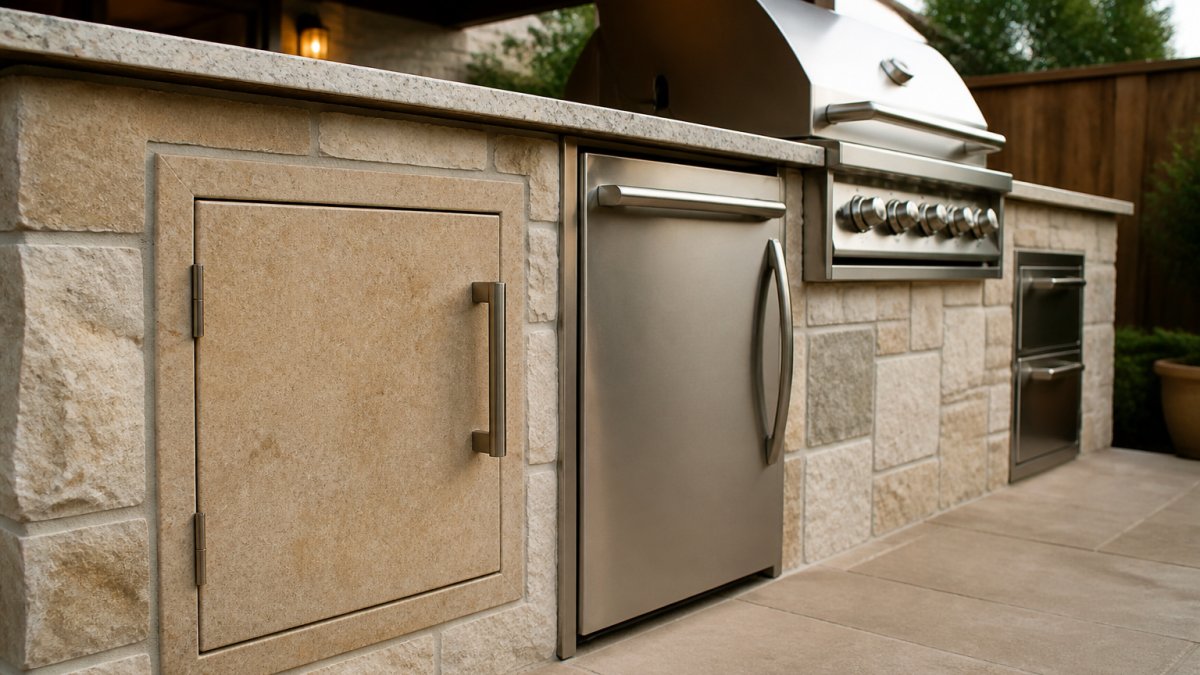
Masonry and Stone Cabinetry
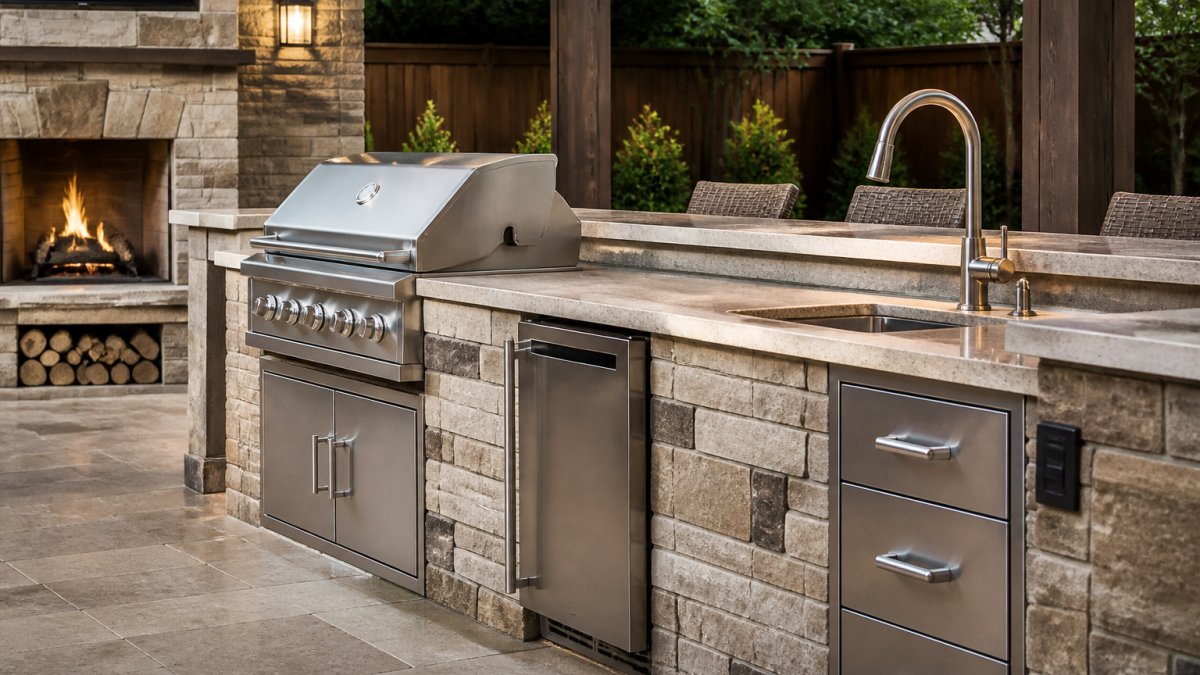
Masonry is the most permanent option: block or steel-stud framing clad in stone veneer, stucco, or brick, often with a concrete or masonry core.
The trade-offs are real. Masonry is heavy and needs proper footings and structural planning. It is difficult to reconfigure later, and interior access for plumbing or gas shutoffs must be designed in from the start.
HDPE and PVC Cabinetry
HDPE (high-density polyethylene) and PVC cabinets are the practical modern answer for homeowners who want a furniture-like look without stone's maintenance. Neither absorbs water, both resist insects and rot, and both hold color well under UV when formulated for outdoor use.
What most guides miss is rigidity. Cheaper HDPE doors can feel flexible and sag on wide spans, so frame construction and hinge quality matter as much as the material.
Stainless Steel Outdoor Kitchen Cabinets: Durability and Trade-Offs
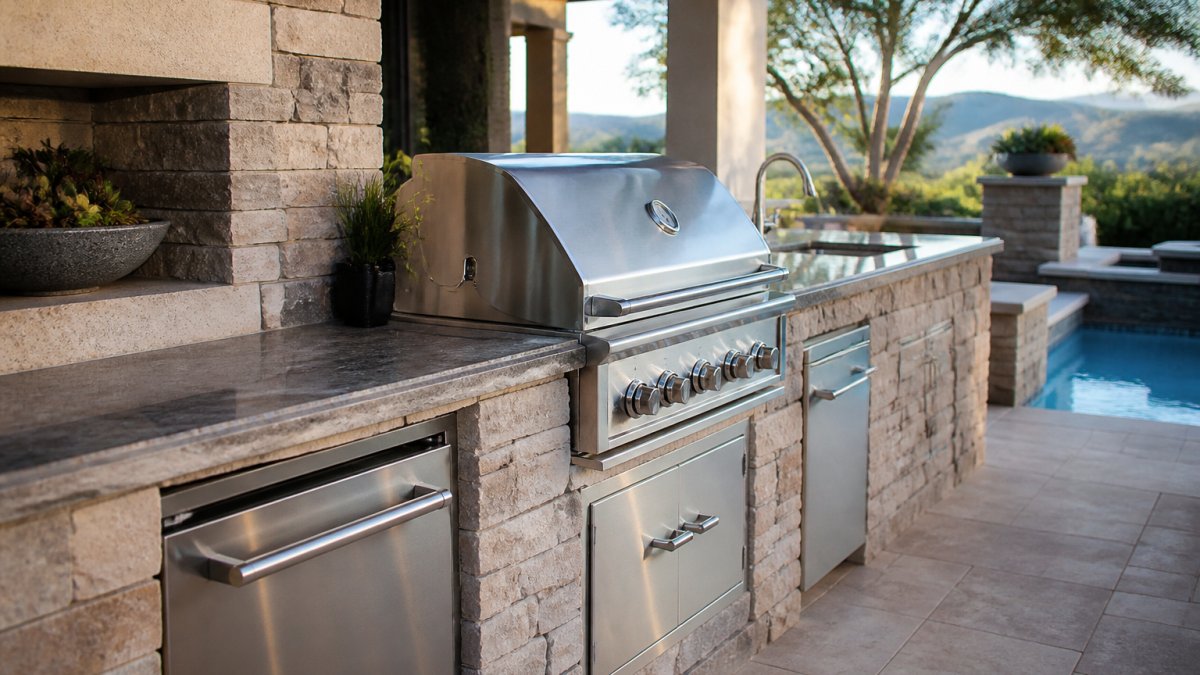
Stainless steel outdoor kitchen cabinets are the most durable mainstream choice for wet, high-use zones, provided the grade is right.
Durability is not the issue with stainless; heat transfer and appearance are. Metal cabinets get warm in direct afternoon sun, and fingerprints and water spots show on brushed finishes.
There is also a specification trap. Thin-gauge steel doors feel tinny and dent, and non-stainless hardware corrodes first, aging the whole cabinet.
Outdoor Kitchen Countertop Materials That Handle Sun and Freeze-Thaw
The best outdoor kitchen countertop materials balance heat resistance, stain resistance, and freeze-thaw stability. Granite, porcelain, and engineered surfaces like Dekton lead the field; sealed concrete and some quartz products are riskier outdoors.
Granite, Porcelain, and Engineered Surfaces
Granite remains the benchmark for natural stone. It handles direct heat, resists scratching, and each slab is unique.
Porcelain and engineered surfaces such as Dekton resist UV fading, stains, and heat, and need no sealing.
Concrete is popular and often misunderstood. It can perform well outdoors but is prone to hairline cracking and needs sealing and occasional refinishing.
| Countertop | Heat Resistance | Sealing Needed | Main Risk Outdoors |
|---|---|---|---|
| Granite | High | Yes, periodically | Water spotting, staining if unsealed |
| Porcelain | High | No | Edge chipping on impact |
| Dekton (engineered) | High | No | Fabrication and edge detail sensitivity |
| Sealed concrete | Moderate | Yes, regularly | Hairline cracking, freeze-thaw damage |
Outdoor Kitchen Material Comparison: Lifecycle Cost and Repairability
An outdoor kitchen material comparison that stops at the sticker price is incomplete. Total cost of ownership includes maintenance, repair, and replacement, and the cheapest material up front is rarely the cheapest over a decade of North Texas sun, hail, and freeze-thaw. The useful comparison is what each material asks of you after installation.
The four cost buckets to compare
Every premium material carries costs in four places. Line them up side by side before you commit:
- Upfront material and fabrication. Stone veneer, thick-gauge stainless, and large-format porcelain slabs cost more per square foot than HDPE panels, and fabrication (cutting, edge profiling, mitering) adds labor that varies widely by material.
- Routine maintenance. Sealing, cleaning products, and the labor to apply them. Granite and sealed concrete need periodic resealing; porcelain, Dekton, HDPE, PVC, and 304/316 stainless generally do not.
- Repair after damage. Hail dings, chipped edges, cracked slabs, corroded hinges, and faded doors all have different repair paths and different odds of an invisible fix.
How the leading materials actually behave over time
HDPE and PVC. Moderate upfront cost, no sealing, and modular replacement.
Stainless steel. Moderate to high upfront cost depending on gauge and grade.
Granite. High upfront cost, periodic resealing, and water-spot management on dark slabs.
Porcelain and engineered surfaces (Dekton and similar). High upfront cost, no sealing, excellent UV and stain resistance.
Sealed concrete. Moderate upfront cost, regular sealing and occasional refinishing, and the least predictable structural behavior.
A practical way to choose
Pick the material whose failure mode you can live with. If a visible chip would bother you for years, favor modular cabinetry where a single part can be swapped. For the lowest ongoing attention, prioritize materials that need no sealing and pair them with a covered structure that reduces UV and rain exposure. The cheapest ten-year outcome is usually the material that needs the least intervention, not the lowest invoice on day one.
Matching Materials Across the Whole Kitchen
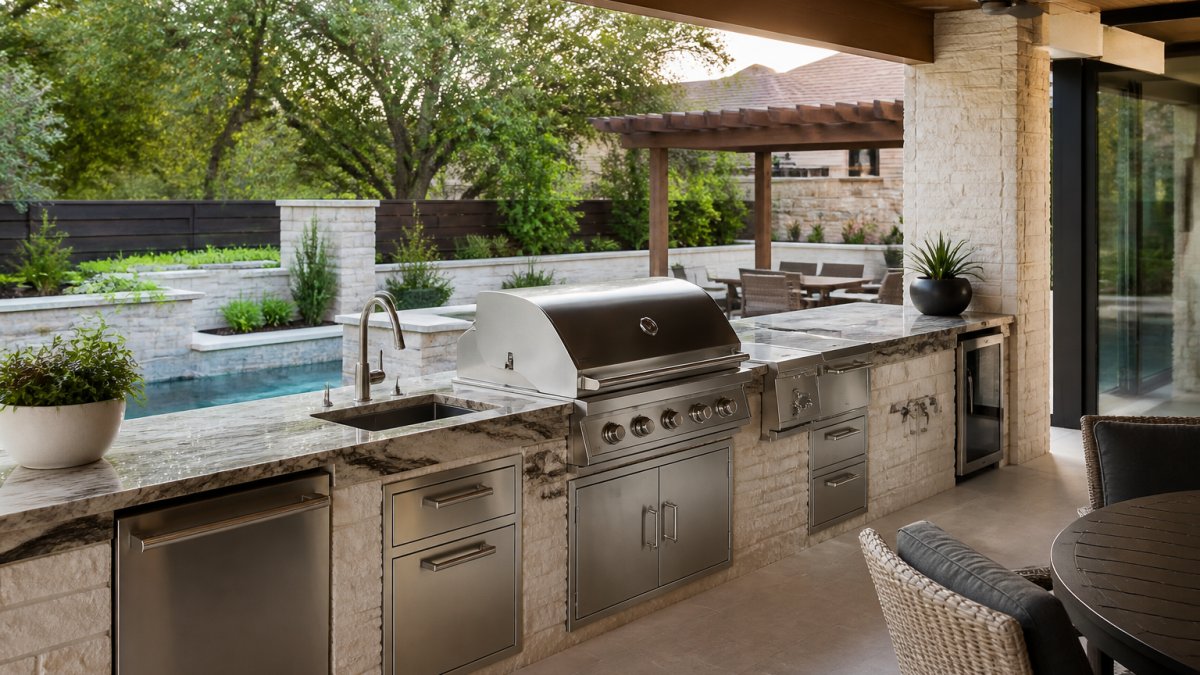
Material compatibility is where most outdoor kitchens quietly go wrong. A premium countertop on a moisture-trapping substrate, or stainless cabinets fastened with the wrong screws against an unsealed masonry wall, creates a failure point no single material review would catch. The real question is how frame, doors, countertop, fasteners, appliances, and finishes behave as one system.
Differential movement at every joint
Different materials expand and contract at different rates under the same sun. Where a stone countertop meets a metal cabinet, or a masonry wall meets a wood-framed element, the joint needs flexible, exterior-rated sealant rather than rigid grout. Rigid joints crack as materials move; flexible joints absorb it. That is why the sealant schedule matters as much as the material list, and belongs in routine maintenance, not a one-time step.
Galvanic corrosion and mixed metals
When two dissimilar metals touch in moisture, the less noble metal corrodes faster. Standard steel screws into stainless hinges, or aluminum framing contacting stainless panels, creates exactly this condition. Keep fasteners and hardware stainless throughout and isolate dissimilar metals with a barrier where they must meet. Hardware fails first on a stainless cabinet, and mixed-metal contact is usually why.
Moisture paths behind and under the finish
Stone veneer over a moisture-trapping substrate, or a countertop with no drip edge, sends water where it cannot evaporate. Cabinets need ventilation so moisture escapes the cavity, and countertops need a slight pitch or drip edge so water runs away from the cabinet face. A sealed cavity with no vent is a slow-motion failure regardless of door material.
Heat clearance around grills and side burners
Appliances radiate heat into their surrounds. The material immediately around a grill or side burner should be rated for that heat, and the manufacturer's required clearances should be followed rather than tightened for a cleaner look. Heat-rated surrounds and correct clearances protect both the appliance and the cabinetry beside it.
Finish and color as a system
A minimalist design with one dominant material and one accent usually ages better than a patchwork of finishes and makes future repairs easier to match. When a door or panel needs replacement, a restrained palette gives you a realistic chance of a close match years later.
Why this favors a single team
Compatibility is a design decision, not a purchasing decision. It is settled when frame, countertop, fasteners, and appliance surrounds are specified together, before anything is ordered. That is the practical advantage of one team handling cabinets, countertops, and structure: joints, metals, moisture paths, and clearances are planned as one system instead of discovered on site.
Installation Details That Prevent Premature Failure
Installation, not material choice, often causes many outdoor kitchen failures. The right material installed wrong fails faster than a mid-grade material installed correctly.
- Footings and substrate: Cabinets and countertops need a stable, level base. Settling shows up as cracked countertops and doors that no longer close.
- Fasteners and hardware: Use stainless fasteners throughout. Standard screws and hinges corrode and stain the surrounding finish.
- Sealant at every joint: Flexible, exterior-rated sealant at countertop-to-wall and countertop-to-cabinet joints. Reapply as part of routine maintenance.
Conclusion
The challenge with outdoor kitchens is not finding premium materials; it is choosing a set that works together and installing them to survive North Texas summers and freeze-thaw winters.
That is the work we do at Villefort Luxury Outdoor Living. We design and build complete outdoor environments, from custom outdoor kitchens and covered patios to pools, spas, and pergolas, with premium materials, transparent communication, and hands-on attention from consultation to final walkthrough.
Frequently Asked Questions
What is the best material for outdoor kitchen cabinets?
There is no single best answer, because the right choice depends on your climate, budget, and how much maintenance you want. In North Texas, stainless steel cabinets resist heat, moisture, and insects with little upkeep. Masonry and stone give a built-in, high-end look but are heavy and hard to reconfigure. HDPE and PVC are lightweight, moisture-resistant, and budget-friendly, though they can look less premium. Compare cabinet frames, doors, and hardware together, since mixing materials badly is a common cause of early failure in outdoor kitchens.
Is stainless steel a good choice for outdoor kitchen cabinets?
Yes, for many homeowners. Stainless steel outdoor kitchen cabinets resist corrosion, moisture, and UV fading, and they clean up easily after cooking. Marine-grade stainless holds up better near salt air or heavy humidity than lower grades. The trade-offs: the surface shows fingerprints and scratches, and it can feel hot in direct afternoon sun. Check the grade and finish before you commit, and confirm the hardware is stainless too, since mismatched hinges and screws are a frequent failure point.
What countertop material lasts longest in an outdoor kitchen?
Granite and porcelain both hold up well outdoors. Granite resists heat, scratches, and stains, and it handles sun exposure without fading. Porcelain and engineered surfaces resist moisture, UV, and staining, and they are lighter and easier to maintain, though edges can chip if struck hard. Sealing matters: natural stone needs periodic sealing to resist moisture and staining, while porcelain generally does not. Your choice should match how you cook and how much maintenance you are willing to do.
Can you use natural stone for an outdoor kitchen countertop?
Yes. Granite, and stone veneer on cabinet faces, are common in high-end outdoor kitchens. Natural stone handles heat and sun well and gives a one-of-a-kind look. The catch is maintenance: most natural stone needs sealing to resist moisture, oil, and staining, and it can crack if the base is not built to handle expansion and contraction. Freeze-thaw cycles and heavy sun both stress stone, so proper installation and a stable substrate matter as much as the slab itself.
What materials hold up best in sun, rain, and temperature changes?
Materials with strong UV, moisture, and heat resistance do best: stainless steel, porcelain, granite, and HDPE or PVC. In North Texas, the bigger stress is intense sun and wide temperature swings rather than salt air, so UV resistance and freeze-thaw resistance both matter. Avoid materials that warp, fade, or absorb water, and confirm that sealants, adhesives, and hardware are rated for outdoor exposure. Material compatibility across the whole kitchen, not just one surface, is what keeps it holding up.
How do you choose low-maintenance materials for an outdoor kitchen?
Start with how much upkeep you will actually do. Stainless steel, porcelain, and HDPE need the least routine care: wipe down, rinse, and occasional cleaning. Natural stone and concrete look great but need periodic sealing and more careful stain management. Ask about repairability too, since a scratched or chipped surface that can be refinished or replaced locally saves money over time. A material comparison that weighs service life against maintenance is more useful than picking the most expensive option.
Ready to start your backyard design? Tell us how you want to cook, entertain, and relax outdoors, and we will help you choose materials built for the long haul.