 how-to
How Do You Manage a Backyard Renovation Budget?
Last Updated: November 1, 2026
Quick Summary
To manage a backyard renovation budget, build a written planner before design that splits your total spend across design, permits, site prep, hardscape, materials, labor, and a contingency reserve. Track estimates against actuals weekly and tie every payment to a completed milestone.
- A complete budget covers six buckets, and most first-time budgets miss site prep and permits entirely.
- Reserve roughly 10% to 20% of total project cost as contingency, with utility or grading work at the higher end.
- Rank projects by use, difficulty to add later, and impact, starting with drainage and grading.
- Compare two or three bids on identical scope, since the lowest number is not the winner.
- Flag any line running more than 10% over estimate and review the contingency balance monthly.
Table of Contents
- Start With a Realistic Backyard Renovation Budget
- Build a Backyard Renovation Budget Planner Before You Design
- How to Prioritize Backyard Renovation Projects
- Set a Backyard Renovation Contingency Budget
- Run a Backyard Renovation Contractor Estimate Comparison
- Track Spending and Payments Through Construction
- Request Your Backyard Design Estimate
- Frequently Asked Questions
Start With a Realistic Backyard Renovation Budget
A backyard renovation budget is a written plan that splits your total spend across design, materials, labor, permits, and a reserve for surprises.
The numbers involved are larger than most homeowners expect. NerdWallet's landscaping cost guide notes that projects can run from under $100 for basic lawn care to $100,000 or more for a full backyard with an inground pool.
At Villefort Luxury Outdoor Living, we walk DFW homeowners through this planning stage before design begins. The goal is simple: know what you can spend, then design to that number instead of discovering it later.
What Your Budget Must Cover
A complete budget has six buckets:
- Design and engineering - drawings, site survey, structural details
- Permits and inspections - fees and review time
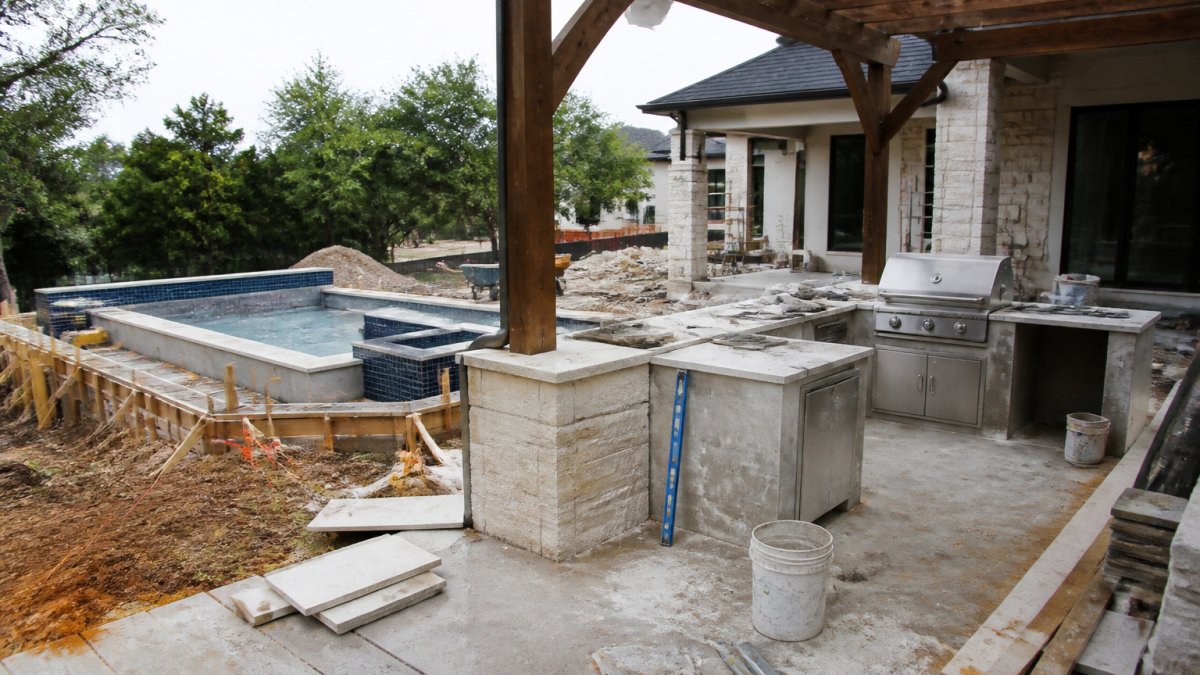
- Site prep - grading, drainage, demolition, utility work
- Hardscape and structures - patio, pergola, kitchen, pool shell
- Materials and finishes - stone, concrete, tile, appliances
- Labor and project management - crews, trades, oversight
Most first-time budgets miss site prep and permits entirely. Those two lines are where overruns usually start.
Build a Backyard Renovation Budget Planner Before You Design
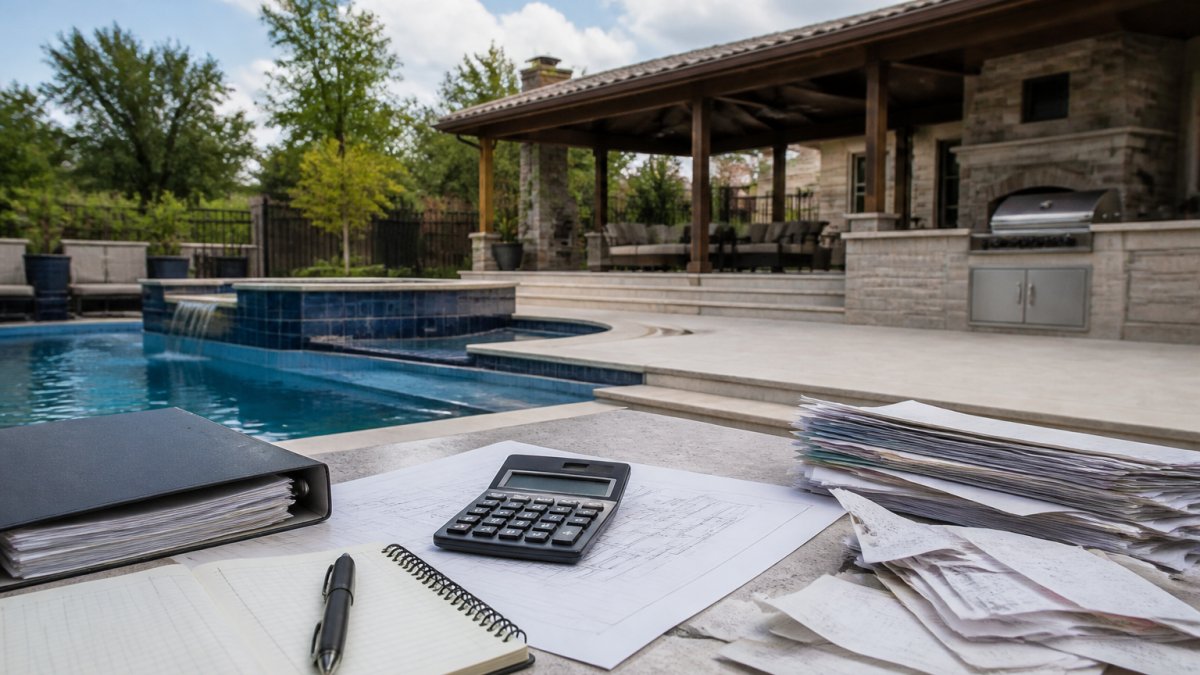
A backyard renovation budget planner is a simple spreadsheet or worksheet that lists every line item, its estimated cost, and its actual cost as work moves forward. Build it before design, not after.
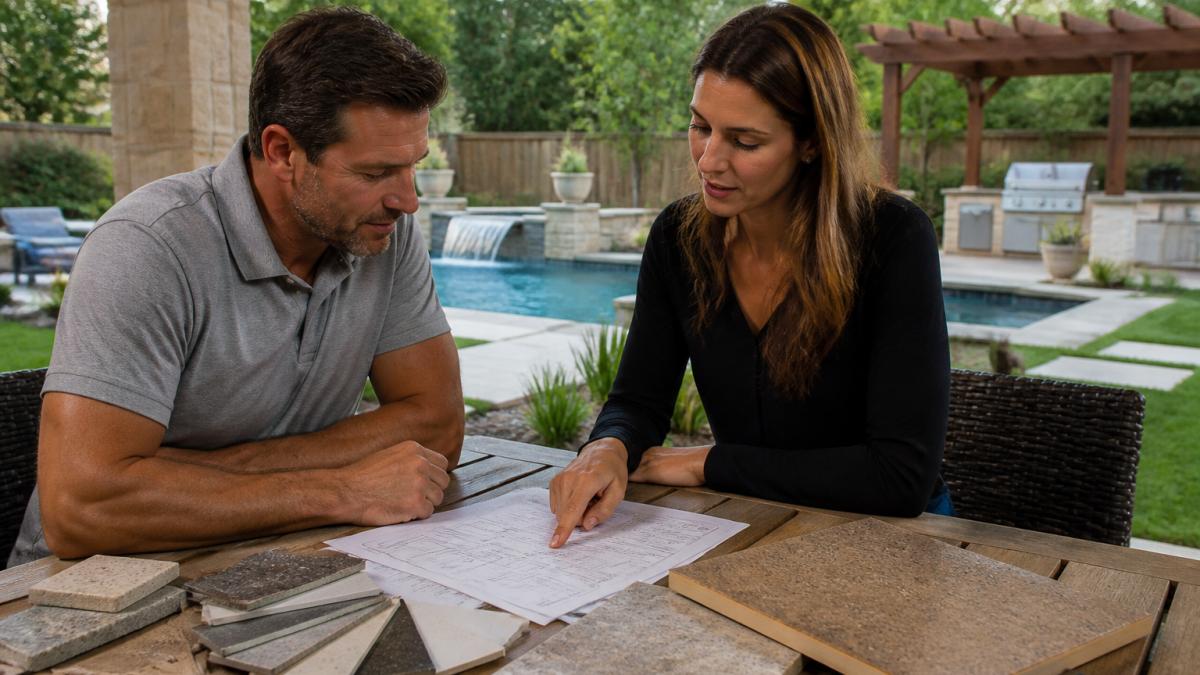
Here is the logic most people get backwards: the planner drives the design, not the other way around. When you hand a designer a real number, you get options that fit.
Worksheet Line Items to Track
Set up one row per item with four columns: estimate, actual, difference, and notes. The estimate column should be filled in before you meet a designer; the actual column gets updated every time an invoice arrives.
| Line Item | Estimate | Actual | Notes |
|---|---|---|---|
| Design fees | $ | $ | Revisions included? |
| Permit fees | $ | $ | Allow review time |
| Site prep and grading | $ | $ | Drainage scope |
| Patio or hardscape | $ | $ | Square footage basis |
| Pergola or shade structure | $ | $ | Material choice |
| Outdoor kitchen | $ | $ | Appliance allowance |
| Pool or spa | $ | $ | Equipment package |
| Landscaping | $ | $ | Plant and sod allowance |
| Contingency | $ | $ | Hold untouched |
| Total | $ | $ | Compare weekly |
How to Fill In the Estimate Column
An empty table is not a planner. Before you can compare bids or set a design ceiling, you need a defensible number in every row. Most homeowners build those numbers in three passes:
- Start with a target total. Decide what you can spend without borrowing beyond a comfortable level. That number is the ceiling every other line has to fit under.
- Allocate by category, not by wish list. A common pattern is to reserve roughly half of the total for hardscape and structures, a quarter for site prep and utilities, and the remainder for design, permits, finishes, and contingency. The exact split shifts with scope, but writing it down forces trade-offs early.
- Convert big-ticket items to unit pricing. Instead of guessing a patio number, multiply square footage by a per-square-foot range for the material you are considering. Do the same for pergola spans, kitchen linear feet, and pool perimeter. Unit pricing makes it obvious when one line is eating the budget.
Track the Difference Column, Not Just the Total
The difference column is where the planner earns its keep. A line that runs 10% over estimate is a signal, not a rounding error. Review the difference column weekly and flag any line that drifts. If three lines drift in the same direction, the scope is probably larger than the design assumed, a conversation worth having before the next invoice, not after.
Update the actual column every time an invoice arrives. A planner only works if it stays current.
How to Prioritize Backyard Renovation Projects
Rank projects by three filters: how often you'll use it, how hard it is to add later, and how much it affects everything else. Structural work like drainage, grading, and the patio base always comes first. You cannot build a kitchen on bad drainage.
Homeowners back this up. According to Alan's Factory Outlet's backyard trends infographic, 62% of homeowners rank landscaping and aesthetics as a top backyard priority, and 48% cite outdoor seating.
A practical order for most properties:
- Drainage and grading
- Patio and hardscape footprint
- Shade structure or pergola
- Outdoor kitchen and fire features
- Pool and spa
- Planting and finishing details
If the budget is tight, stop at step three. A well-built patio with shade beats a half-finished kitchen every time.
Set a Backyard Renovation Contingency Budget
A backyard renovation contingency budget is money you set aside and do not spend unless something unexpected appears. Maintaining this financial buffer remains a critical component of managing a renovation budget, ensuring that unforeseen complications do not derail the broader scope of your outdoor improvements.
Watch out: skipping the contingency is the single most common cause of a stalled project. When rock is hit during excavation or a utility line needs rerouting, work stops until someone pays for it.
Great Day Improvements' 2026 State of American Home Renovation report found that 59% of respondents with a planned renovation expected to spend $10,000 or more, and nearly 40% anticipated budgets of $20,000 or more.
For a closer look at where overruns come from and how to head them off, read how to avoid cost overruns in backyard construction.
Run a Backyard Renovation Contractor Estimate Comparison
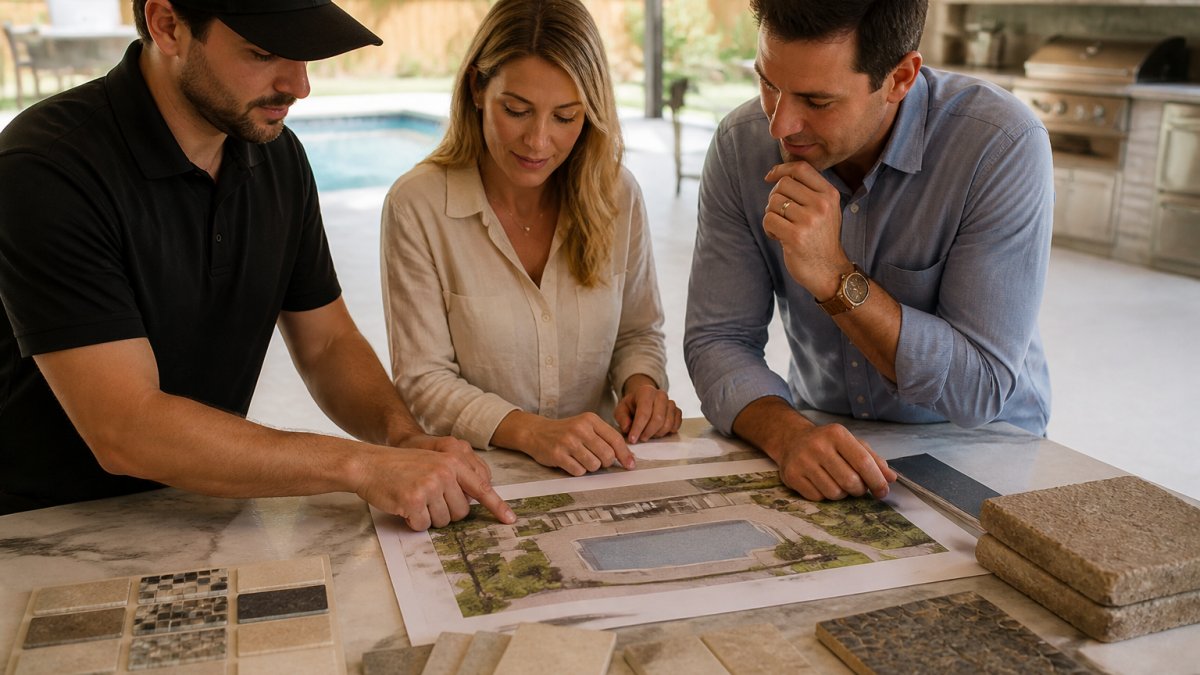
A backyard renovation contractor estimate comparison means putting two or three bids side by side and checking that each one covers the same scope. The lowest number is not the winner. The clearest scope usually is.
Before you compare bids, ask each contractor the same questions:
- What is included, and what is excluded?
- Who pulls the permits?
- Is project management included or billed separately?
- What is the payment schedule?
- How are change orders priced and approved?
If one bid is far below the others, something is missing. It is usually site prep, permits, or project management.
A Bid-Comparison Checklist
Place the bids side by side and list the scope items for comparison. A bid that leaves a row blank is not cheaper, it is incomplete. Check each of these against every bid:
- Scope of work, square footage, linear feet, and counts are stated, not described as "typical" or "as needed."
- Exclusions, demo, haul-off, grading, drainage, utility relocation, and finish work are either included or explicitly excluded.
- Allowances, appliance, tile, lighting, and planting allowances are listed with a dollar figure and a note on what happens if selections exceed them.
- Permits and inspections, the bid states who pulls permits and who pays fees.
- Project management, supervision, scheduling, and site cleanup are either in the bid or billed separately.
- Payment schedule, payments are tied to completed milestones, not to calendar dates or a large deposit up front.
- Change orders, the process for pricing and approving changes is in writing.
- Warranty and closeout, what is covered after completion, and for how long, is stated.
Compare Apples to Apples
Two bids can look similar on the summary page and differ wildly underneath. Normalize them before you decide:
- Convert every line to the same unit, per square foot, per linear foot, per fixture.
- Add back any excluded item at a realistic allowance so the totals reflect the same scope.
- Note which bid includes design revisions and which bills them separately.
- Check whether the bid assumes the same material grade. A paver patio and a stamped concrete patio are not the same line item.
A bid-comparison checklist turns a gut-feel decision into a documented one. For proven steps to vet contractors before committing to an estimate, read how to vet luxury outdoor contractors. It also gives you a fair basis to ask follow-up questions, and a clear record if scope changes later.
For more on this step, see our guidance on how accountability changes between single-contractor and multi-subcontractor models.
Track Spending and Payments Through Construction
Track spending against the planner weekly, and tie every payment to a completed milestone. Never pay for work that hasn't happened yet. A payment schedule built on milestones keeps use in your hands and keeps the budget honest.
Set up a simple weekly routine:
- Match each invoice to a line in the planner
- Update the actual column the same day
- Flag any line running more than 10% over estimate
- Review the contingency balance monthly
- Keep every change order in writing
Most budget blowouts are not one big event. They are a dozen small approvals nobody wrote down.
Request Your Backyard Design Estimate
We would rather give you a clear scope and a realistic number than a low bid that grows later.
Financing options are available, and our financing page explains how homeowners structure larger projects. If you are ready to begin, the pool installation quote guide walks through what the estimate process involves.
Start with a conversation about your goals and your number. Get started with Villefort Luxury Outdoor Living and build an outdoor space designed around both.
Frequently Asked Questions
How much should I set aside for unexpected backyard renovation costs?
A backyard renovation contingency budget is money you hold back for surprises, not money you plan to spend. Most planners set aside a percentage of the total project cost rather than a fixed dollar figure, because the reserve should scale with the size of the build. Hidden site conditions, utility conflicts, and material substitutions are the usual culprits. Keep the contingency in your own account until a change is approved in writing, and treat any unused portion as savings rather than an invitation to upgrade.
What should a backyard renovation budget include?
A complete backyard renovation budget covers design and drawings, permits and inspections, site preparation and grading, hardscaping such as patios and retaining walls, pool and spa construction, outdoor kitchen and pergola fabrication, utilities and drainage, landscaping, lighting, furniture allowances, and a contingency reserve. Add soft costs like engineering reports or survey work if your lot requires them. Listing every line before you request bids is the only way to compare a backyard renovation contractor estimate comparison fairly, because a low bid often just omits scope.
How do I prioritize backyard renovation projects when the budget is limited?
Rank each feature by two measures: how much you will use it and how hard it is to add later. Learn how to prioritize backyard renovation projects by building in phases, starting with the work that is disruptive or structural, such as grading, drainage, utility runs, and the patio base. A pool shell or pergola footing is far cheaper to install before finishes go down. Fire features, lighting, and furniture can follow in a later phase without tearing anything up.
How can I compare backyard renovation contractor estimates?
Ask every bidder to price the same written scope so the numbers are comparable. Check whether each estimate itemizes materials, labor, permits, disposal, and allowances, and whether it states what is excluded. Confirm who handles permits and utility coordination, and ask how change orders are priced and approved. A backyard renovation contractor estimate comparison should weigh communication and process as heavily as price, since the cheapest bid with vague exclusions is usually the one that grows.