 how-to
Can You Avoid Cost Overruns in Backyard Construction?
Last Updated: October 28, 2026
Quick Summary
You can avoid cost overruns in backyard construction by writing a detailed scope of work, setting a layered budget before design, normalizing every bid to that scope, and holding a contingency split between design and construction surprises. Disciplined written change orders and weekly tracking of spend and site conditions catch drift while it is still fixable.
- Set your budget first, then design to it, so decisions carry a cost ceiling.
- Build the budget in three layers: hard costs, soft costs, and contingency.
- Compare bids line by line against your written scope, not on total price alone.
- Require every change order in writing with cost and schedule impact stated.
- Review spend against baseline and site conditions against a risk register weekly.
Table of Contents
- Why Backyard Projects Go Over Budget
- Step 1: Define Your Backyard Project Scope of Work
- Step 2: Set a Realistic Budget Before You Design
- Step 3: Learn How to Compare Contractor Estimates
- Step 4: Build a Construction Contingency Plan
- Step 5: Handle Backyard Construction Change Orders Carefully
- Step 6: Track Spending and Site Conditions Weekly
- Start Your Backyard Design With a Clear Budget
- Frequently Asked Questions
Why Backyard Projects Go Over Budget
Avoiding cost overruns in backyard construction starts with knowing where budgets break. Research on strategies to reduce cost overruns and schedule delays found that senior managers point to weak planning and poor cost control as root causes.
A homeowner sketches a patio on a napkin, gets a rough number, then adds a kitchen, a fire feature, and upgraded stone. The number never catches up.
The usual culprits:
- A scope that lives only in conversation
- Budgets built before design is finished
- Bids compared on total price alone
Cost overruns are the gap between what you planned to spend and what you actually pay. That gap grows fastest when decisions get made twice.
Step 1: Define Your Backyard Project Scope of Work
A backyard project scope of work is a written document that lists every element of the build, the materials, and what is excluded. It can help clarify what is included in a project.
What Belongs in a Written Scope
Your scope should cover:
- Every structure: patio, pergola, kitchen, pool, spa, fire feature
- Dimensions and locations on the lot
- Materials and finishes by name
Watch out: a scope that says "outdoor kitchen" without listing appliances, counter material, and gas line responsibility invites three different interpretations and three different prices.
Write it down, sign it, and treat it as the baseline for every estimate you collect. When a bid comes in low, compare it against this document line by line.
Step 2: Set a Realistic Budget Before You Design
Set your budget first, then design to it. Designing before setting a budget can leave homeowners facing cuts or overruns, because design decisions have been made without a cost ceiling attached.
Build your budget in three layers:
- Hard costs: materials, labor, equipment, and subcontractor work
- Soft costs: design, engineering, permits, inspections, utility locates, and HOA submittals
- Contingency: your cushion for the unknown
Most guides skip the third layer. Do not. A contingency can provide a cushion for soil issues, utility surprises, and weather.
Where Backyard Money Actually Goes
Outdoor projects concentrate spending in a few places. Rather than a single lump sum, build your budget as a line-item worksheet with these categories, and ask every bidder to price against the same list:
- Site preparation and excavation: grading, demo of existing concrete or decking, haul-off, erosion control
- Hardscape and structure: patio slab or pavers, retaining walls, pergola or cover framing, footings
- Utilities and drainage: gas line to the kitchen, electrical runs and conduit, water and sewer tie-ins, French drains, channel drains, sump and grading away from the house
Cost estimating guidance from RSMeans on accurate cost data stresses that current, locally relevant pricing produces more precise plans. Material costs and labor rates move, so a budget built on old numbers is already drifting. Treat older numbers as a starting point to re-confirm, not a commitment.
Size Contingency to Your Site, Not to a Rule of Thumb
The right cushion depends on what your lot is likely to hide:
- Flat, clear, served lot with known utilities: the low end of the range is usually defensible
- Sloped lot, mature trees, or an older home with unrecorded lines: budget toward the high end and hold a separate reserve for utility relocates and root removal
- Pool, structural cover, or full outdoor kitchen: more trades, more inspections, and more interfaces between them, which means more chances for a change order
Write down what each contingency bucket is for before construction starts. A design contingency covers upgrades you choose; a construction contingency covers conditions you did not choose. Mixing them is how homeowners end up with no cushion when the real surprise arrives.
Watch the Line Items That Quietly Grow
Three budget lines cause most of the drift on outdoor projects:
- Allowances. A bid that lists a lighting or appliance allowance is deferring a decision, not pricing it. Ask what the allowance assumes and what happens when you exceed it.
- Owner-supplied items. If you plan to buy the grill, furniture, or tile yourself, confirm who installs it, who warrants it, and whether the contractor's schedule depends on your delivery date.
- Disposal and haul-off. Demo debris, excess soil, and old concrete are billed by load.
Timelines affect cash flow too. If you are planning around financing or a season, review custom outdoor living space timeline expectations so your budget and your calendar line up.
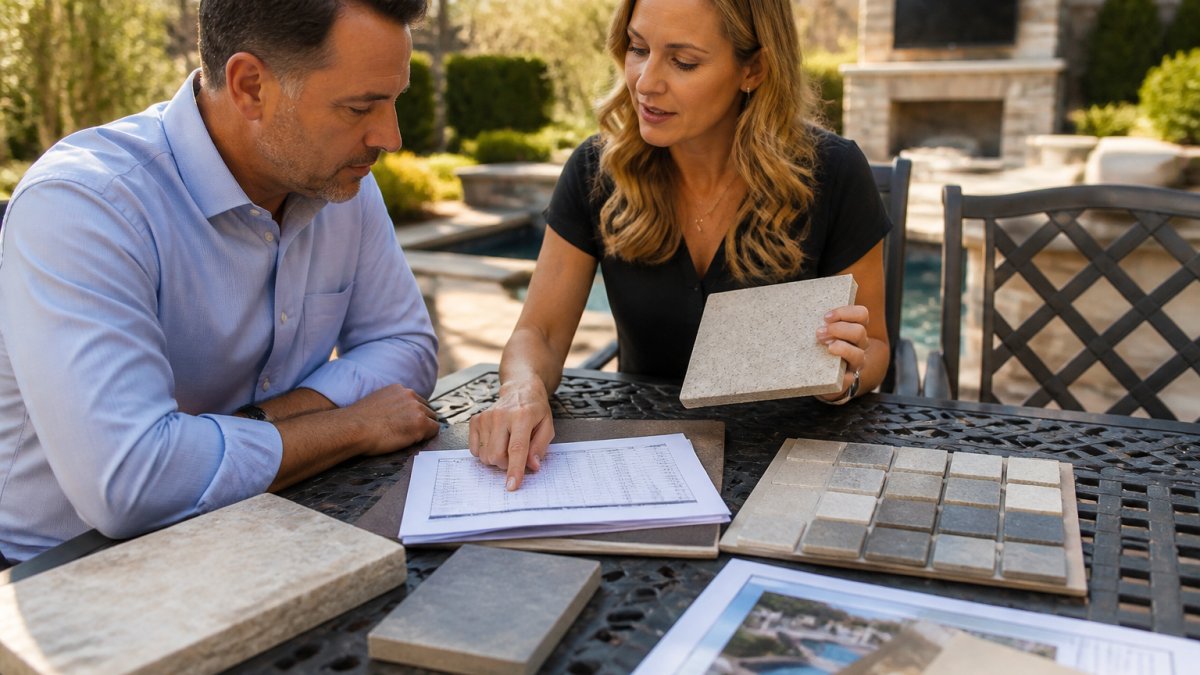
Build your budget as a line-item worksheet with these categories, and ask every bidder to price against the same list.
| Budget category | What it covers |
|---|---|
| Site preparation and excavation | Grading, demo, haul-off, erosion control |
| Hardscape and structure | Patio slab or pavers, retaining walls, pergola framing, footings |
| Utilities and drainage | Gas line, electrical runs, water and sewer tie-ins, drains |
| Pool and spa | Excavation, shell, plumbing, equipment pad, finishes, safety barriers |
| Outdoor kitchen and features | Cabinetry substrate, countertops, appliances, vent hood, fire feature |
| Finishes and fixtures | Stone veneer, lighting, audio, shade structures, furniture allowances |
| Soft costs | Design fees, engineering, permit fees, inspections, HOA review |
Step 3: Learn How to Compare Contractor Estimates
Comparing contractor estimates means normalizing every bid to the same scope, then checking quantities, allowances, and exclusions. The lowest total is often the least complete bid.
Do this with every estimate you receive:
- Match each line item to your written scope
- Check quantities and material specs
- Flag every "allowance" and ask what happens if costs exceed it
An independent cost estimate, one you commission separately from your bidders, gives you a neutral benchmark.
Before you sign anything, learn how to vet luxury outdoor contractors step by step. And if you are weighing one builder against several trades, this breakdown of one contractor vs multiple subcontractors explains the trade-offs.
Step 4: Build a Construction Contingency Plan
Construction contingency planning means setting aside money and a decision process for the unknowns before they appear. A contingency is not padding. It is risk management.
Split it into two buckets:
- Design contingency: for changes you choose, like upgrading a counter or adding lighting
- Construction contingency: for surprises you do not choose, like rocky soil or a rerouted drain line
Agree in writing on who approves draws from each bucket and how you will be notified. A homeowner-ready plan answers three questions: how much, for what, and who decides.
Watch out: dipping into contingency for upgrades early leaves nothing for real surprises later. Protect it.
Step 5: Handle Backyard Construction Change Orders Carefully
A change order is a written amendment to the contract that adjusts scope, price, or schedule.
Treat every change order like a mini contract:
- Require it in writing before work proceeds
- State the cost impact and schedule impact
- Confirm it against your remaining budget
Scope creep rarely arrives as one big request. It shows up as small additions: an extra outlet, a wider patio, a different stone.
Our rule of thumb: if a change pushes total approved changes past your design contingency, pause and re-plan before approving more.
Step 6: Track Spending and Site Conditions Weekly
Weekly cost tracking catches drift while it is still fixable. Guidance from CMiC on preventing construction overruns notes that costs escalate when teams rely on lagging reports instead of current production and spend data.
Run a short weekly review:
- Compare spend to date against your cost baseline
- Log any cost variance and its cause
- Walk the site and note conditions: weather, soil, access, utilities
That is the general discipline. Backyard projects need a second layer, because the conditions that blow outdoor budgets are specific to the lot and rarely show up on a generic construction checklist.
The Backyard Site-Condition Risk Register
Before excavation, walk the property with your contractor and build a short written register of conditions that could trigger added work. For each one, note the likely cost impact, who is responsible, and which contingency bucket would cover it. The categories that matter most:
- Slope and grading. A yard that falls away from the house may need retaining walls, stepped footings, or extra fill. A yard that falls toward the house needs drainage corrected before any hardscape goes down, or the patio becomes a dam.
- Drainage and stormwater. Where does water go during a heavy rain? Channel drains, French drains, dry wells, and regrading are commonly added after the first storm reveals a problem. Ask how the design handles the low point of the lot.
- Soil. Expansive clay is common across much of the region and moves with moisture. That affects footing depth, slab design, and how much excavation is required. A soils report on a complex build is cheaper than a failed slab.
How Site Conditions Connect to Contingency
A risk register is only useful if it drives decisions. Use it this way:
- Price the knowns. Conditions you can see and measure belong in the base bid, not in contingency.
- Reserve for the likely unknowns. Conditions that are probable but unquantified, a suspected root zone, an unmarked private line, get a named reserve in the construction contingency.
- Require written approval before a draw. When a condition turns into added work, the change should cite the register entry, the added cost, and the schedule impact. That is the same discipline described in Step 5, applied to surprises rather than upgrades.
- Review the register weekly. Conditions get resolved, new ones appear, and the reserve should move with them.
Weather and seasonality matter outdoors. Rain delays cascade into labor and material scheduling, and those cascade into cost. Concrete, masonry, and finish work are all weather-sensitive, and a wet season can push a schedule far enough to affect crew availability. For a deeper playbook, read how to avoid backyard construction delays.
Start Your Backyard Design With a Clear Budget
The challenge is simple: most backyard budgets fail before construction starts, in the planning stage.
Villefort Luxury Outdoor Living manages the full transformation under one vision, with transparent pricing and reliable scheduling, premium materials and skilled craftsmanship, and hands-on attention from consultation to final walkthrough.
Ready to plan with confidence? Learn how to book a custom backyard design consultation, or reach out for a free estimate and start your backyard design.
Frequently Asked Questions
What commonly causes backyard construction projects to go over budget?
The biggest drivers are an undefined scope, allowances that were never validated against real material costs, and changes approved verbally mid-build. Site surprises matter too: soil conditions, drainage, and utility locations can add work nobody priced. Construction cost-control guidance points to the same root problem, namely decisions made on lagging information instead of current production and spend data. A written scope, a validated estimate, and a contingency line set before ground breaks can help homeowners plan for these risks.
How should I set a contingency for a backyard construction project?
Treat construction contingency planning as a separate budget line, not spare cash. Size it to the unknowns your site actually carries: older drainage, uncertain soil, or a design still being finalized all argue for a larger reserve. Ask how the contingency is tracked and how decisions about its use are made. Ask your builder to show how the reserve is tracked and who signs off before it is spent.
How do change orders affect a construction budget?
Every backyard construction change order should state the added cost, the schedule impact, and the reason in writing before work proceeds. Signed change orders keep the budget honest; verbal ones turn into disputes. Ask for a running change log so you can see the total of approved changes against your original cost baseline at any point. If change orders start arriving weekly, review the plan and the reasons for the changes before approving more.
What should I do if my backyard project is already over budget?
Stop approving new work and get a written cost-to-complete from your contractor: what has been spent, what remains, and what it will cost. Compare that against your original estimate line by line to find where the variance sits. Then review options such as adjusting the project scope. Tracking costs against the original estimate can help you understand the variance.
Your backyard deserves a plan that holds up. Get started with Villefort Luxury Outdoor Living and build the outdoor space you have been planning, on a budget that stays where you set it.