 blog
One Contractor vs Multiple Subcontractors: Which to Hire?
Table of Contents
- One Contractor vs Multiple Subcontractors: The Core Trade-Off
- Advantages of Hiring One Contractor for Your Backyard Build
- Advantages of Hiring Multiple Subcontractors Directly
- Cost Savings vs Contractor Markup: An Apples-to-Apples Comparison
- Subcontractor Coordination, Scheduling, and Trade Sequencing
- Questions to Ask a General Contractor Before You Sign
- Your General Contractor Contract Checklist
- A Realistic Backyard Project Contractor Timeline
- Frequently Asked Questions
Last Updated: October 19, 2026
One Contractor vs Multiple Subcontractors: The Core Trade-Off
The contractor vs subcontractors decision comes down to a single exchange: you trade money for time and risk. At Villefort Luxury Outdoor Living, we build custom patios, outdoor kitchens, pergolas, and pools across the Dallas-Fort Worth area, and we've watched homeowners succeed with both models.
A general contractor is a single point of contact who contracts with specialist trades, sequences their work, and answers for the finished result. An independent contractor works directly for you, with no intermediary.
Advantages of Hiring One Contractor for Your Backyard Build
Pool, pergola, outdoor kitchen, and hardscape work depend on each other. The pool shell has to be excavated before the patio base goes in. Gas and electrical rough-ins must happen before finishes close up walls.
The practical benefits stack up quickly:
- Single point of contact. One call handles a delay, a defect, or a change.
- Trade sequencing built in. The schedule reflects dependencies instead of guesses.
- Accountability that doesn't bounce. You aren't refereeing between two trades who each blame the other.
For a busy professional who doesn't want a second job, that structure is worth real money, accountability is written into one contract, not scattered across five.
Advantages of Hiring Multiple Subcontractors Directly
Going direct can save money. A general contractor carries overhead, insurance, and profit in the price; skip the middle layer and those costs come off the top.
Direct hiring also gives you control. You pick the mason, the electrician, and the pool builder yourself, negotiate each scope, and see each written estimate line by line.
The catch is what you take on. One Reddit remodeling discussion on single versus multiple contractors raises the point that a single contractor may cost more while absorbing coordination, though the thread offers no verified cost comparison.
Cost Savings vs Contractor Markup: An Apples-to-Apples Comparison
Most cost comparisons get this wrong. They compare a general contractor's total bid against the sum of subcontractor quotes and call the difference savings, ignoring the work you're about to do for free and the costs that only show up after the first trade walks off the job.
A fair comparison puts both options on the same footing. Instead of asking which number is lower, ask which number is complete.
Build a Like-for-Like Scope First
The biggest source of false savings is comparing bids that don't cover the same work. Write one scope document listing every line item, demolition, excavation, utilities rough-in, structural work, finishes, cleanup, and disposal, then ask each contractor and each trade to price that same list. If a direct subcontractor quote omits site protection, debris hauling, or final grading, add a line for it yourself.
The Four Costs a Bid Comparison Usually Misses
A general contractor's price includes overhead, insurance, supervision, and profit, the markup. That markup is real, and it's the first thing homeowners try to remove. But removing it transfers four costs onto you:
- Your coordination time. Scheduling five trades across several months is a part-time job. Price your hours honestly, even if you're not paying yourself.
- Contingency. Change orders and rework happen on nearly every build. A direct-hire budget needs a cushion for the surprises a contractor would otherwise absorb.
- Rework risk. When one trade's work blocks another's inspection, the redo bill lands on whoever holds the contract. Direct hiring means that's you.
A Comparison Worksheet You Can Actually Use
Rather than trusting a single bottom-line number, score both options on the same rows:
| Line item | One contractor | Multiple subcontractors |
|---|---|---|
| Quoted scope (same list for both) | Included | Included per trade |
| Markup / coordination fee | Built into price | None, but you coordinate |
| Your estimated hours × your rate | Low | High |
| Contingency allowance | Contractor carries it | You carry it |
| Rework exposure | Contractor | You |
| Permit and inspection responsibility | Contractor | You |
| Payment schedule complexity | One schedule | One per trade |
The point isn't to declare a winner. It's to see that the apparent gap between a contractor bid and direct quotes shrinks once your time, contingency, and rework exposure are on the page.
We don't publish prices, because every backyard differs in scope, materials, and site conditions. What we will say is that the cheapest bid is rarely the cheapest project.
Subcontractor Coordination, Scheduling, and Trade Sequencing
Scheduling is where direct hiring quietly falls apart. Backyard builds follow hard dependencies: excavation, then utilities, then structural work, then finishes.
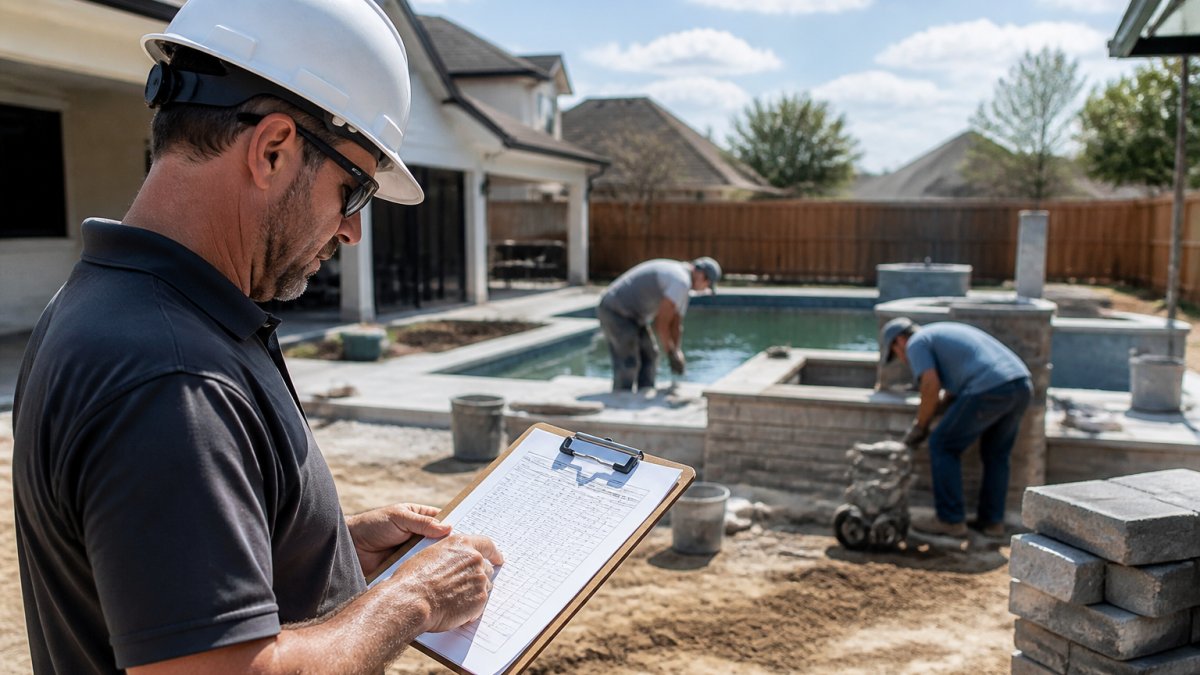
A general contractor plans around those dependencies, knowing the electrician can't rough in until the trench is inspected. When you hire directly, you hold that map, and most homeowners learn it mid-project.
The Dependency Chain in a Typical Backyard Build
Trade sequencing isn't guesswork, it follows the order in which work can be inspected and closed up. A common pattern looks like this:
- Demolition and site prep. Clearing, grading, and excavation must finish before anything underground begins.
- Underground rough-ins. Gas, electrical conduit, and plumbing go in and get inspected before they're buried or covered.
- Structural work. Pool shell, pergola footings, and patio base depend on the rough-ins being signed off.
- Inspections. Each jurisdiction inspects at set stages; a failed inspection stalls every trade behind it.
- Finishes. Stone, stamped concrete, kitchen surfaces, and fixtures close up the work and can't be redone cheaply.
- Landscaping and cleanup. Final grading and planting come last because heavy equipment damages finished surfaces.
Each step gates the next, so a single missed inspection or late material delivery cascades through every trade booked behind it.
Who Owns the Schedule When a Trade Falls Behind?
The contractor owns it when you hire one. Your contract should state that the contractor manages the schedule and absorbs the cost of resequencing caused by a trade they hired.
When you hire directly, you own it. If the mason no-shows, you call the next one, renegotiate the timeline, and explain the delay to every other trade, manageable on a simple project, brutal on a complex one.
A Decision Framework: Complexity vs. Your Available Time
Rather than choosing all-or-nothing, score your project on two axes before you decide who coordinates:
- Project complexity. Count the trades involved and the number of hard dependencies between them. A stamped concrete patio with no utilities is low complexity. A pool, outdoor kitchen, pergola, and hardscape on one site is high complexity because every trade gates another.
- Your available time. Be honest about the hours you can give to calls, site visits, inspections, and rescheduling. A homeowner with a flexible schedule and a simple project can coordinate directly. A homeowner with a demanding job and a complex build is buying back risk by hiring a coordinator.
High complexity plus low available time points toward one contractor. Low complexity plus high available time is where direct hiring earns its savings.
The Hybrid Model Most Comparisons Skip
You don't have to pick one extreme. A practical middle path is to hire a general contractor for coordination and sequencing while directly contracting a specialist you already trust, a pool builder or landscaper you've worked with before. The contractor still owns the schedule and dependencies; your specialist handles their own scope under the same sequence. This works best when the specialist's work is clearly separable and the contractor agrees in writing to coordinate around it.
Questions to Ask a General Contractor Before You Sign
Ask about process, not promises. The answers reveal how a contractor actually runs a build.
- Who supervises the site day to day, and how often will I see them?
- Which tasks are subcontracted, and how do you vet those trades?
- How do you handle a change order, and who signs off?
A contractor who answers these without flinching is showing you their systems. One who deflects is showing you something else.
Your General Contractor Contract Checklist
A solid contract protects both sides. Use this checklist before signing:
- Scope of work written line by line, with materials named
- Written estimate separate from the contract, itemized
- Payment schedule tied to completed milestones, not dates
- Change order process in writing, including approval steps
Insurance, Licensing, and Liability in Texas Backyard Projects
Texas doesn't license general contractors statewide, so verification falls to you. Ask for certificates of general liability insurance and workers' compensation, and confirm the policy is current. Pool and electrical work often involves separate licensing, so ask which trades hold which credentials. The Texas Department of Licensing and Regulation publishes requirements for regulated trades, and local building departments handle permits and inspections.
A Realistic Backyard Project Contractor Timeline
Timelines vary with scope and weather, so treat any schedule as an estimate, not a promise. A typical sequence:
- Design and permitting. Plans, selections, and permit submission.
- Site prep and excavation. Clearing, grading, and digging.
- Utilities rough-in. Gas, electrical, and plumbing before finishes.
- Structural work. Pool shell, pergola footings, patio base.
- Finishes. Stone, stamped concrete, kitchen surfaces, fixtures.
- Landscaping and cleanup. Final grading, planting, walkthrough.
Rain slows excavation. Inspections add days. Material lead times shift. A contractor who tells you the schedule will flex is being honest; one who promises a fixed date isn't.
Coordinating multiple trades on a complex backyard build is a job, and most homeowners don't have the hours for it. Villefort Luxury Outdoor Living manages the entire transformation under one vision, from design and permitting through trade sequencing and the final walkthrough.
Frequently Asked Questions
Is it cheaper to hire subcontractors directly or use a general contractor?
Direct hiring can look cheaper on paper because you skip the contractor's markup on labor and materials. But the comparison rarely stays apples-to-apples. When you hire trades yourself, you absorb the cost of your own time, repeated site visits, and rework when one trade's work conflicts with another's. A general contractor bundles coordination, site supervision, and quality control into that markup. The real question is whether the markup buys you enough protection on a project of your scope. For complex builds with pools, utilities, and structures, that coordination usually pays for itself.
Who coordinates subcontractors on a backyard construction project?
That depends entirely on your hiring model. With a general contractor, subcontractor coordination sits with the builder: they sequence trades, schedule inspections, and hold each crew to the scope of work. If you hire trades directly, you become the coordinator. That means confirming arrival times, checking that one trade's work is finished before the next starts, and resolving conflicts when a crew falls behind. Before choosing a model, be honest about how many hours per week you can spend on site and on the phone.
What happens if one subcontractor delays the rest of the project?
A single late trade can cascade through the whole schedule. Concrete crews, electricians, plumbers, and finishers all depend on each other, so a missed deadline can push inspections and finish work back by days or weeks. Under a general contractor, the builder absorbs that risk and resequences the schedule, which is one reason contracts include contingency language. If you coordinate trades yourself, you own the rescheduling, the calls, and any cost impact from idle crews. Ask upfront how delays are handled and who pays for them.
What should a general contractor contract checklist include?
At minimum, your contract should spell out the scope of work, a written estimate, the payment schedule and deposit terms, and how change orders are priced and approved. It should name who pulls permits and who is responsible for inspections and building codes. Confirm licensing, insurance, and liability coverage in writing, and check how warranty and workmanship issues are handled after completion. A clear dispute resolution clause matters too. If any of these items are missing or vague, ask for them in writing before you sign or pay a deposit.