 blog
Best Alternatives to Archadeck for DFW Outdoor Projects
Table of Contents
- Why DFW Homeowners Search for Archadeck Alternatives
- How to Compare Outdoor Living Contractors in DFW
- Questions to Ask a Deck Contractor Before You Sign
- Covered Patio Contractors in DFW: What to Look For
- Finding an Outdoor Kitchen Builder Near Me in North Texas
- Material and Design Trade-Offs for North Texas Conditions
- Villefort Luxury Outdoor Living: A Single-Contractor Option
- Conclusion
- Frequently Asked Questions
Last Updated: October 19, 2026
Why DFW Homeowners Search for Archadeck Alternatives
Searching for the best alternatives to Archadeck for DFW projects usually starts with a simple frustration: the scope of work has outgrown what a single franchise branch can comfortably deliver. At Villefort Luxury Outdoor Living, we hear this from homeowners in Plano, Frisco, and McKinney who want a covered patio, outdoor kitchen, and pool that read as one design rather than three separate installs.
Franchise systems bring process discipline, but also territory boundaries and standardized product lines, both shape what your project can become.
What a Franchise Model Means for Your Project
A franchise is a locally owned business operating under a national brand's methods, materials, and design catalog. That delivers consistency, but design choices often run through corporate approval, and the local owner's ability to expand into pools, hardscaping, or landscape work depends on what the franchisor permits.
If your wish list stays inside the brand's catalog, a franchise can be a solid fit. If it crosses categories, you may end up coordinating two or three companies yourself, and you become the project manager.
How to Compare Outdoor Living Contractors in DFW
Comparing contractors comes down to five things: scope, licensing and insurance, communication, schedule honesty, and change-order handling. A contractor who scores well on all five will usually deliver a sound project even when surprises come up.
The Five-Point Comparison Framework
Score each contractor from 1 to 5 on each line of every bid you receive, then total it.
| Criterion | What to Verify | Why It Matters |
|---|---|---|
| Scope | Can they handle every element you want? | Fewer handoffs, fewer delays |
| Licensing and insurance | Current state and local credentials, liability and workers' comp coverage | Protects you from liability if something goes wrong |
| Communication | Named point of contact, response expectations in writing | Prevents the "he disappeared" problem |
| Schedule honesty | Realistic sequencing, weather contingencies stated upfront | Sets expectations you can plan around |
| Change orders | Written approval process before extra work begins | Keeps the budget from drifting |
A contractor strong on scope but vague on change orders is a budget risk; one who communicates well but subcontracts the pool to a stranger is a coordination risk. The framework forces you to see the whole picture.
Questions to Ask a Deck Contractor Before You Sign
Most contractor checklists stop at "are you insured?" That's table stakes. The questions that separate a sound deck contractor from a risky one are about verification, who holds the license, who pulls the permit, who signs off on inspections, and what happens after the last board goes down.
Verify the Business Before You Verify the Bid
Start with the entity, not the pitch. In Texas, a residential project above a certain contract threshold triggers a written contract requirement under the Texas Property Code, and the contractor's business name and license information should appear on it. Ask for:
- The exact legal business name and the name on the insurance certificate, they should match.
- A current certificate of liability insurance and proof of workers' compensation coverage, sent directly from the insurer or agent rather than forwarded as a PDF the contractor assembled.
- The name of the individual who will hold the building permit, since the permit holder is the party the local inspections department will call when something fails.
Permits, Inspections, and Who Owns the Risk
Deck and covered patio work in North Texas runs through municipal permitting and inspection, and the sequence matters. Ask:
- Who pulls the permit? If the answer is "you do," that is a red flag for a project of any real scope. The contractor should pull it under their own name.
- Which inspections apply? Footing, framing, and final are typical for structural work; electrical and gas add their own inspections. Ask the contractor to name them.
- Who schedules inspections, and who meets the inspector on site? The answer should be the contractor, not you.
No contractor can guarantee permit approval, that decision belongs to the local authority. A good contractor can explain how they prepare and what they do when a plan reviewer asks for changes.
Warranty and Post-Completion Questions
Ask for the written warranty before you sign, not after. A workmanship warranty and a manufacturer warranty are two different documents, and both should be in hand. Ask:
- How long does the workmanship warranty run, and what does it exclude?
- Who honors the manufacturer warranty if the product fails, the contractor, the manufacturer, or you?
- What is the process for a callback, and what response time is stated in writing?
The Questions Most Homeowners Forget
- Which parts do you build in-house, and which do you subcontract? Subcontracted pools, gas lines, and electrical are common, but you should know who is on your property.
- Who is my single point of contact, and how quickly do they respond? Get a name and a stated response window.
- How do you document and price changes once construction starts? A written change-order process protects both sides.
Covered Patio Contractors in DFW: What to Look For
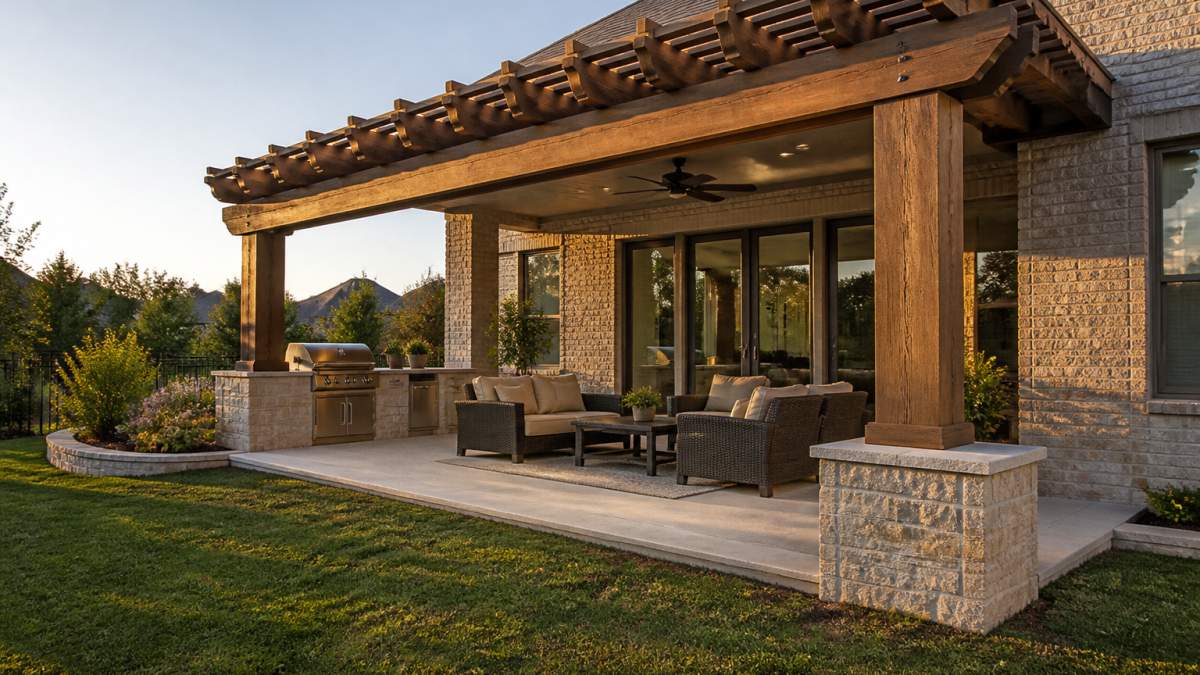
A covered patio is a structural and drainage problem first and a design problem second. Roof attachment, water runoff, foundation connection, and ceiling height determine whether the space stays comfortable and dry for decades.
The Roof Tie-In Is Where Leaks Begin
A covered patio roof has to tie into the existing house roof, and that intersection is the most common failure point. Ask the contractor to explain:
- How the new roof plane meets the existing one. A proper tie-in uses flashing and underlayment that shed water away from the joint, not caulk and hope.
- Whether the new roof pitch matches or complements the house. A shallow patio roof that dumps water against the house is a problem waiting for the first heavy rain.
- How the ceiling height was set. Too low and the space feels like a shed; too high and the structure may need engineering the contractor did not plan for.
Ask to see a completed covered patio and look up at the tie-in, not just out at the furniture.
Drainage and North Texas Clay Soil
North Texas clay soil expands and contracts with moisture, and flat work that drains poorly will pond, sometimes against the foundation. A contractor should describe:
- Where water leaves the slab. Slope, channel drains, and downspout routing should all be part of the plan.
- How the patio connects to the existing foundation. A slab that bears independently of the house is different from one tied into it, and the choice affects movement and cracking.
- What happens to roof runoff. Water from a new patio roof has to go somewhere; if it lands against the house or in a low spot, you will find out the first spring.
Permits and Trade Sequencing
Covered patio work typically involves a building permit and inspections for footing, framing, and final, plus electrical for fans or lighting and gas for a fire feature or outdoor kitchen connection. Ask:
- Who pulls the permit and meets the inspector.
- Which trades are subcontracted and who sequences them.
- How the patio design accounts for a future outdoor kitchen or pool deck, so you are not tearing up finished work later.
A contractor who designs the patio as a standalone build and a contractor who designs it as part of a larger outdoor living plan will give you very different answers. The second is the one to keep talking to.
A covered patio that looks finished can still be a drainage problem in waiting. If a contractor cannot explain where water goes when it leaves the roof and slab, keep looking.
Finding an Outdoor Kitchen Builder Near Me in North Texas
An outdoor kitchen builder near you should explain ventilation, gas line routing, counter material behavior in heat, and equipment clearances before you discuss finishes.
North Texas summers are brutal on outdoor materials. A counter that looks elegant in a showroom can stain, crack, or hold heat.
The coordination question is the one most homeowners forget. An outdoor kitchen touches masonry, plumbing, gas, electrical, and sometimes the pool equipment pad.
Material and Design Trade-Offs for North Texas Conditions
Material choice in North Texas is a trade-off between heat, moisture, and maintenance, not a search for a perfect product. Cedar handles heat and takes stain well but needs periodic refinishing.
| Material | Strength in North Texas | Watch Out For |
|---|---|---|
| Cedar | Handles heat, stains beautifully, classic look | Needs refinishing every few years |
| Composite decking | Resists moisture and UV fade, low upkeep | Higher upfront cost, warmer surface |
| Stamped concrete | Durable hardscape, flexible patterns | Requires proper jointing and sealing |
| Natural stone | Timeless appearance, strong heat tolerance | Heavier structural requirements |
Design trade-offs matter too. A pergola adds shade without a solid roof, suiting homeowners who want light. A covered patio blocks sun and rain but needs structural planning. Fire features extend the usable season into cooler months.
Villefort Luxury Outdoor Living: A Single-Contractor Option
For homeowners who want one team accountable for the entire backyard, Villefort Luxury Outdoor Living designs and builds cohesive outdoor environments under one vision.
That structure answers the question we hear most: "If something goes wrong with permits or utilities, who fixes it?" With one contractor owning the full scope, the answer is the same company you signed with.
Where it fits best is the complex project that crosses categories and would otherwise require you to manage several companies.
The difference from a franchise model comes down to scope flexibility and design cohesion. One team, one plan, one point of contact for the whole backyard.
The right contractor is the one whose scope matches your whole wish list and whose communication style matches your tolerance for being involved. Verify both before you sign anything.
Conclusion
The hardest part of choosing among the best alternatives to Archadeck for DFW isn't finding contractors. It's finding one whose scope, communication, and accountability match a project spanning patios, kitchens, pools, and landscape.
If your project crosses categories, start with a conversation rather than a bid. Villefort Luxury Outdoor Living handles custom design, premium materials, skilled craftsmanship, and hands-on attention from consultation through final walkthrough, with transparent pricing and financing options available.
Frequently Asked Questions
Is Archadeck a national company?
Yes. Archadeck operates as a franchise network with locally owned locations across the country, including the Dallas-Fort Worth area. That means the quality of your experience depends heavily on the specific local franchise owner and crew, not on the national brand itself. When comparing Archadeck alternatives, ask each company whether the people designing and building your project are employees or subcontractors, who holds the contract, and who handles warranty claims after the project wraps up.
How do I compare outdoor living contractors in DFW?
Start with a five-point comparison: licensing and insurance, portfolio depth in projects like yours, communication process, written scope and change-order policy, and warranty terms. Ask for references from projects similar in size to yours and actually call them. Confirm the company carries general liability and workers' compensation coverage. Compare at least three bids on the same written scope so you are evaluating apples to apples, and be wary of any contractor who will not put details in writing.
What should I ask a deck or patio contractor before hiring?
Ask who will manage your project day to day, whether permits are included in the scope, how change orders are priced, and what the payment schedule looks like. Request proof of insurance, the names of the subcontractors they use, and a sample warranty. Ask how they handle utility conflicts or inspection delays. A contractor who answers these questions clearly and in writing is showing you how the whole project will run.
How can I check an outdoor living contractor's references and past work?
Request three to five references from projects completed in the last year that resemble yours in scope, and call each one. Ask about communication, timeline accuracy, and how punch-list items were handled. Ask to see photos of finished work and, when possible, visit a completed project. Cross-check reviews on Google and the Better Business Bureau, and confirm the company's registration with the Texas Secretary of State if it operates as an LLC or corporation.