 ultimate-guide
How to Simplify Your Backyard with One Contractor
Last Updated: November 4, 2026
Quick Summary
The benefits of a single contractor for outdoor projects include one budget, one schedule, and one point of contact for permits, liability, and warranty claims. One team resolves constructability on paper before work starts, reducing handoffs, rework, and the surprises that come from separate crews.
- Design-build puts design and construction under one contract, with the contractor managing the project instead of you.
- A 2026 IMA Financial Group report found 63% of contractors had a project postponed, scaled back, or canceled.
- Permit requirements vary by municipality and can change between the design phase and the application date.
- Checkpoints like verifying grades before a pour catch problems while they are still cheap to fix.
- Ask every contractor for a current certificate of insurance and read the scope language for exclusions.
Table of Contents
- Why One Contractor Beats a Patchwork of Trades
- Design-Build vs. the Fragmented Approach
- How a Single Contractor Manages Your Outdoor Kitchen Construction Cost Factors
- Managing Backyard Construction Timelines Under One Roof
- One Point of Contact for Permits, Liability, and Accountability
- A Cohesive Design Vision Across Every Outdoor Feature
- Quality Control and Rework Prevention from One Team
- Start Your Backyard Design with One Team
- Frequently Asked Questions
Why One Contractor Beats a Patchwork of Trades
The benefits of single contractor outdoor projects start with a simple fact: a backyard is one system, not five separate jobs. When a pool builder, a mason, an electrician, and a landscaper each work from their own plan, the seams between their work become your problem. This guide from Villefort Luxury Outdoor Living breaks down where that fragmentation costs homeowners time, money, and peace of mind, and how one accountable team closes those gaps.
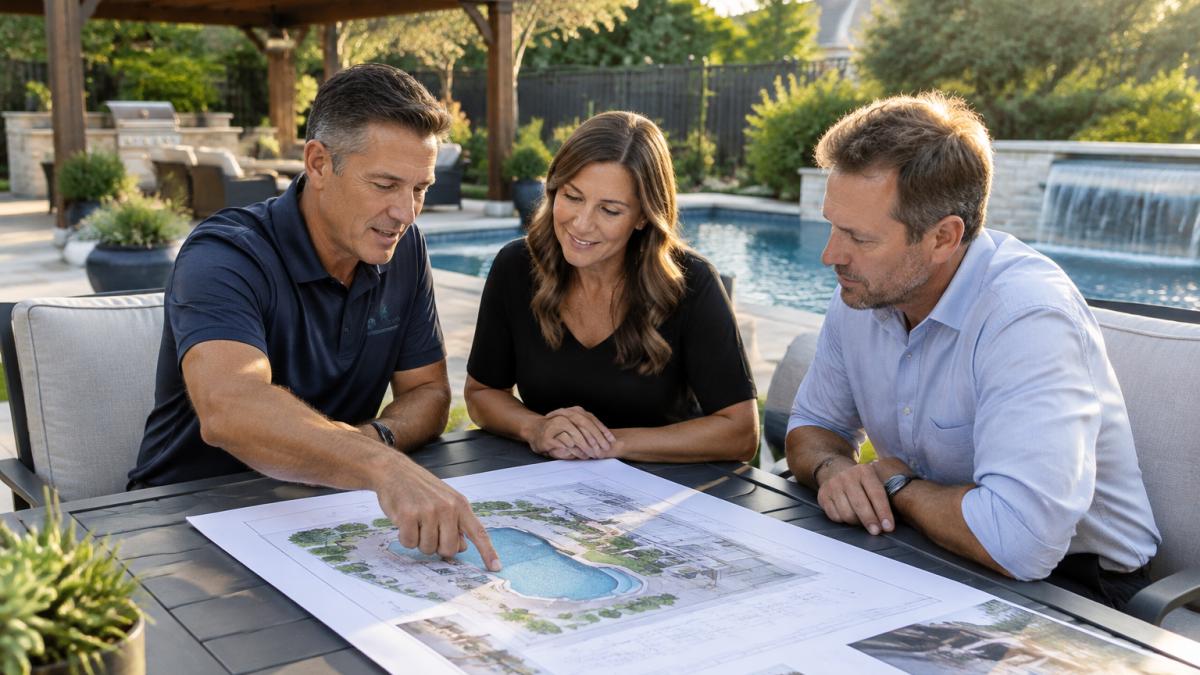
The man is American. The woman is American. The contractor is American.
The Hidden Cost of Coordinating Separate Crews
The hidden cost is you. Someone has to sequence the trades, chase down schedules, and referee disputes when the electrician's conduit lands where the hardscaping crew planned to pour. That someone is usually the homeowner, and it's unpaid work with real consequences.
A common mistake is hiring the cheapest bid per trade and assuming the savings hold. In practice, the gaps between contracts are where rework happens: a slab poured before utilities are stubbed, a pergola footing that conflicts with an irrigation line. Each fix delays the next crew and adds cost nobody budgeted for. A 2026 IMA Financial Group construction market report noted that 63% of contractors reported at least one project postponed, scaled back, or canceled in the prior six months, a reminder of how fragile multi-party schedules can be.
Design-Build vs. the Fragmented Approach
Design-build means one team handles design and construction under a single contract. The fragmented approach splits those responsibilities across a designer and multiple trade contractors, with the homeowner acting as project manager in between.
The difference shows up in how decisions get made. In a fragmented build, the designer draws what looks right and the trades figure out what's buildable, often after materials are ordered. In design-build, the people detailing the pergola are the same people who will set its footings, so constructability gets resolved on paper. Research on early contractor involvement published through Taylor & Francis found that improved constructability and better-quality solutions ranked among the most valued benefits of bringing the builder in early. That's the core argument for one team: fewer handoffs, fewer surprises.
Here is how the two delivery models differ on the points the article raises.
| Aspect | Design-Build | Fragmented Approach |
|---|---|---|
| Who holds the contract | One team for design and construction | Designer plus multiple trade contractors |
| Who manages the project | The single contractor | The homeowner acts as project manager |
| When constructability is resolved | On paper, before work starts | Often after materials are ordered |
| Handoffs and surprises | Fewer handoffs, fewer surprises | More handoffs between parties |
How a Single Contractor Manages Your Outdoor Kitchen Construction Cost Factors
Outdoor kitchen construction cost factors are easier to control when one party owns the whole scope. Site prep, utility runs, countertop material, appliance selection, and shade structures all interact, and a single contractor can price them as one coordinated package instead of five overlapping bids.
The biggest driver most homeowners underestimate is sequencing. Gas lines, electrical, and water have to be roughed in before finishes go down. Get the order wrong and you pay twice. A single team sets that sequence up front. For a closer look at the design and feature options that shape an outdoor kitchen, see our outdoor kitchens service page.
Where Budgets Slip and How One Team Prevents It
Budgets slip in the seams: change orders caused by trade conflicts, allowance overruns nobody tracked, and rework from miscommunication. A single contractor can hold one budget and one change-order process, so a decision change produces one revised number. For a practical walkthrough of keeping a backyard project financially on track, read can you avoid cost overruns in backyard construction.
Managing Backyard Construction Timelines Under One Roof
Managing backyard construction timelines comes down to sequencing and accountability. One contractor builds the schedule around the critical path, so pool excavation, utility rough-in, hardscaping, and planting happen in the right order rather than whenever each crew is free.
Watch out: the most common schedule killer is a trade that shows up before the site is ready, then has to return later. Every return trip adds days. Controlling when each phase starts reduces that risk. Weather and permitting affect every outdoor build, so a realistic schedule is built around real dependencies. Our guide to avoiding backyard construction delays covers the tactics in detail.
One Point of Contact for Permits, Liability, and Accountability
Accountability is the benefit homeowners feel fastest. One point of contact means one phone number, one project manager, and one party responsible when something needs fixing, whether it's a permit question or a utility conflict. But the deeper advantage shows up in two areas most homeowners don't think about until something goes wrong: permitting and liability.
How a Single Contractor Coordinates Permits Across Trades
Outdoor projects rarely need just one permit. A covered patio may require a building permit and a zoning check on setbacks. A pool typically needs its own permit plus barrier and electrical inspections.
When multiple contractors each pull their own permits, nobody owns the overall inspection sequence. That same discipline in sequencing and accountability makes vetting a construction contractor essential when a pool is part of the backyard project.
Watch out: permit requirements vary by municipality and can change between the design phase and the application date, so a scope that was exempt last year may require a full submittal this year. We coordinate the process and plan for that reality; final approval always rests with the local authority, and no contractor can promise an approval outcome in advance.
Why One Contract Reduces Legal and Insurance Exposure
Liability on a fragmented project is spread across multiple contracts, each with its own scope language, indemnity clause, insurance certificate, and warranty terms.
A single contract consolidates that exposure. A single contract can give one scope document and one contracting party to coordinate responsibility for the work. That matters most at the seams, the junction between pool coping and deck, the penetration where a gas line enters a kitchen island, the flashing where a patio cover meets the house, because those are the places where separate trades most often point at each other.
A Cohesive Design Vision Across Every Outdoor Feature
A cohesive outdoor living space reads as one environment, not a collection of purchases. When the same team designs the pool deck, pergola, fire feature, and softscaping, materials, proportions, and sightlines align across every element.
This is where aesthetic consistency earns its keep. A paver chosen for the patio should relate to the pool coping and the kitchen backsplash. Plantings should soften hardscaping rather than fight it. With separate crews, each picks materials in isolation and the yard looks pieced together. With one team, material procurement follows a unified vision, and the finished space feels intentional from every angle.
Quality Control and Rework Prevention from One Team
Quality control works when the same team that builds also inspects. Rework prevention starts with construction oversight at each phase: checking grades before pouring, verifying utility depths before backfill, and confirming finishes before the next trade covers them up. A common mistake is treating inspection as a final walkthrough. By then, correcting a slope or a footing is expensive. One contractor builds checkpoints into the schedule, so problems surface while they're still cheap to fix.
The Checkpoints That Actually Prevent Rework
Checkpoints during an outdoor build matter because the cost of correcting a problem rises at every stage, from grade and slope before a concrete pour to drainage before the final walkthrough.
Those checkpoints matter because the cost of a fix multiplies at every stage. Correcting a grade before a pour is a scheduling adjustment; correcting it after stamped concrete is placed means demolition, re-pour, and a color match that may never be exact. A single team owns every checkpoint because the same people who set the grade are the ones who pour and finish, so there is no gap between the crew that checks and the crew that builds.
One Point of Contact After the Project Closes
Every outdoor build involves components from multiple manufacturers, pumps, heaters, appliances, lighting, pavers, and finishes, and each carries its own warranty terms and claim process. On a fragmented project, a warranty issue means figuring out which trade installed the failing component, whether that trade is still in business, and which manufacturer warranty applies. Homeowners end up chasing multiple parties for a single failure.
With one contractor, warranty claims route through one point of contact. With one contractor, a homeowner has a single point of contact for questions that arise after the project, though specific warranty and maintenance terms should be confirmed directly with Villefort. Ask any contractor how they handle warranty claims after closeout and who the homeowner calls in year three, the answer tells you whether the single-source advantage survives the final invoice.
Project Tracking Keeps Quality Visible
Keeping clients updated throughout a project supports transparent communication and quality control. When one team owns the schedule and the documentation, the record of what was checked and when stays in one place, which is exactly what you want if a question arises months or years later.
Start Your Backyard Design with One Team
Coordinating a backyard across separate crews is possible, but it quietly transfers the hardest parts of the job, scheduling, sequencing, and accountability, onto you. A single contractor takes that weight back and turns a patchwork of trades into one managed process with one vision and one point of contact.
At Villefort Luxury Outdoor Living, we handle the entire transformation under one roof: custom designs tailored to your home, transparent pricing and reliable scheduling, and hands-on attention from the first consultation through the final walkthrough. If you're weighing one team against many, our comparison of one contractor vs. multiple subcontractors is a good next read. Ready to see what's possible? Book a custom backyard design consultation and start your backyard design with a team that owns every detail.
Frequently Asked Questions
How does a single contractor simplify the permitting process for backyard projects?
A single contractor handles permit applications, inspections, and code requirements as part of one coordinated scope. Instead of each trade pulling separate permits and scheduling separate inspections, one team tracks every approval and sequences work around them. This reduces gaps between inspections and keeps the project moving. Ask any contractor how they manage permits and who is responsible for inspection scheduling before you sign.
Does using one contractor for pools and landscaping improve project timelines?
It can. When one company manages pool excavation, hardscaping, and planting, the sequence of work can be planned so one trade does not undo another's work. Fewer handoffs generally mean fewer idle days waiting on a separate crew to show up.
What should homeowners look for when vetting a single-source outdoor contractor?
Look for a clear scope of work, a named project manager, a written schedule, and a process for change orders. Ask who holds the contract with each trade, how permits are handled, and what happens if weather delays work. Request references from projects similar to yours and confirm insurance coverage. A contractor who answers these questions directly is more likely to deliver a smooth build.
How does one contractor manage quality control across multiple trades?
In general, a single contractor can set one quality standard across trades and inspect work at each phase before the next trade begins, which helps prevent rework such as a paver crew covering a utility line that was not inspected.